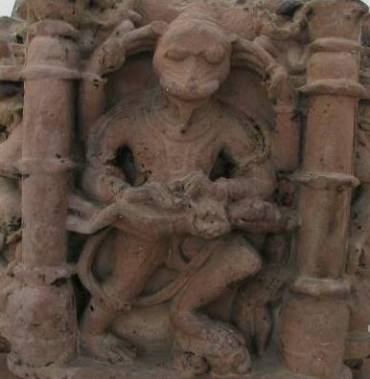
This 5th century sculpture from the outskirts of Jhansi town is probably the oldest intact nR^isiMha image in North India, with some possible exceptions of even older ones in central nepAla.
bhAratendu
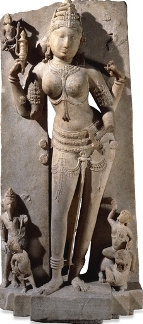

This 5th century sculpture from the outskirts of Jhansi town is probably the oldest intact nR^isiMha image in North India, with some possible exceptions of even older ones in central nepAla.
Posted in Art & Sculpture, History | Leave a Comment »
Posted in Culture | 11 Comments »
kahA kahUM ratiyA kI kathA batiyA kahi Avata hai na kacHU rI
Ayi gopAla liyo bhari a~Nka kiyo mana bhAya piyo rasa kU rI
tAhI dinA soM gaDI aMkhiyAM rasakhAni mere a~Nga a~Nga me pUrI
pai na dikhA.i parai aba bAvari dai ke biyoga bithA kI majUrI
(prema-vATikA.114)
{How do I describe that night dear, for words are escaping my tongue;
gopAla came, took me in his embrace, did what he liked, and we tasted the nectar;
And since that day, as if every pore of rasakhAn’s body has become eyes, waiting for him –
As he has not returned since, and I am left with this gift of his, this madness, this pain, this agony…}
The recent discussions on homosexuality brought to our mind that great poet of braja-bhAShA, Syed Ibrahim Piyani turned vaiShNava sAdhu rasakhAna, for whom his homosexuality itself had become the vehicle to reach kR^iShNa-devotion.
There are of course many unknown things about rasakhAna, including his parentage and early life, and we have no intentions to go into much of those details, in brief what stands almost certain from internal evidence of his own writings is that he was a homosexual, was a paThAna, used to live in dillI, and most scholars of Hindi history consider him a contemporary of Akbar. We however feel that he was an old man by the time of Akbar, and must have rather seen those times when himU had suppressed the last of Afghans and was crowned in dillI. (We have seen some hints of its mention in a couple of his lines, but that will require more analysis.)
The vaiShNava hagiography by gokuladAsa called ‘dosaibAvana vaiShNavan kI vArtA’ (Discussion on 252 vaiShNava-s) recounts the life of rasakhAna, and provides some details about rasakhAna’s homosexual beginning and how through it he turned to devotion. Reproduced below is the relevant part of the prose (#218):
“so vA dillI me eka sAhUkAra rahato hato | so vA sAhUkAra ko beTo baDo sundara hato vA cHoro so rasakhAna ko mana laga gayo | vAhI ke pIcHe phiryA karai vAko jhUTo khAve ATha pahara vAhI kI naukarI karai |… eka dina chAra vaishnava milaki bhagvadvArtA karate hate | karate karate aisI bAta nikasI jo prabhu me aisa lagAvanA jaise chitta sAhUkAra ke beta me lagyo hai…”
In summary, he used to live in dillI and been in homosexual relationship with a certain vaishya’s son, with whom he used to spend day and night and the story of their scandalous affaire was well known in the town. Once he was passing by a group of vaishnava sAdhu-s and got curious overhearing their discussion. (One sAdhu said that one must develop love for the Lord like this paThAna loves that vaishya boy). His curiosity drew him to them and when he asked he was shown a picture of kR^iShNa in shrI-nAtha form (some other descriptions mention it in muralI-manohara form, although little difference it makes). The image was so attractive that rasakhAna’s heart was immediately struck by its beauty, and he fell in love, as rasakhAna himself says in one of the dohA-s recorded in prema-vATikA: ‘prema-deva kI cHabi lakhi, bhaye miyA rasakhAna’ – one glance at the image of the Lord of Love, and miyA became rasakhAna.
He then visited vR^indAvana, and started roaming around in the company of vaiShNava vairAgI-s, eventually taking dIkShA in puShTi mata from the son of famous vallabhAchArya, composing and singing love songs for his new love, and eventually becoming the famous rasakhAna. His poems are mostly in the savaiyyA meter, and present an entirely unique strain of devotion. Above all, one can find such expressions in his work that would easily remind one of his homosexual beginnings.
It seems Moslems did not take kindly to his conversion, and some complained against him with the emperor (Akbar?), although there is no mention of any persecution of rasakhAna except for this line that he wrote: “kahA karai rasakhAna ko ko.U chugala-labAra | jo pai rAkhana-hAra hai mAkhana-chAkhana-hAra” (What harm can these petitioners bring to rasakhAna, for his protector is now none lesser than kR^iShNa himself.)
According to janaShRuti, towards the end of his life he once heard a recitation of rAma-charita-mAnasa (which must have been composed just recently by young tulasIdAsa), and took to its reading and hearing very lovingly.
His immortal, famous last-wish:
mAnusa hauM tau vahI rasakhAna basauM mili gokula gaoM ke gvArana
jo pasu hauM tau kahA basu mero charauM nita nanda kI dhenu majhArana
pAhana hauM tau vahI giri kau jo dharyo kara cHatra purandara kArana
jo khaga hauM tau basero karauM mili kAlindI kUla kadamba kI DArana
(If reborn as a human, then wish to be reborn as rasakhAna, living among those shepherds of gokula;
And if I have to be reborn as an animal, for what control do I have in it, then wish to be born as a cow that would graze together with the cows of nanda;
And if I be sent as a stone, then let me be on that hill, which my Lord picked up due to the wrath of purandara;
And if I become a bird, then I wish I shall make home on the branches of those kadamba trees that grow on the banks of holy yamunA)
bhAratendu records about rasakhAna in his uttara-bhaktamAla, and counting him among other moslem-turned-Hindu devotees, he ecstatically concludes: “ina musalmAna harijanan pai koTina hinduna vAriye”: (the gain of such hari-jana musalmAns makes cheaper to me the loss of a million Hindus.)
Posted in History, Literature | 3 Comments »
continues from Part-1, Part-2 , Part-3, Part-4
While we have sufficient data about Akbar’s U-turn from the onwards of year 1576-77, that is generally coinciding with the time from which the Shiites got engaged, and the process stands fairly coherent after the year of 1580-81 when Akbar was done with the religion of the Prophet, our knowledge is woefully challenged by the insufficiency as well as lack of satisfactory clarity of data available about the happenings in the neighborhood of 1575-76. We are left only with badAyUnI narrating for us the events from this initial stage of the process, without the benefit of corroboration either from the IsAists or the informants of the dabistAn’s author.
We have already seen that down to this time Akbar was under major influence of the sUfI-s, originally of the naqshabandiyA variety but for many years now of their chishtI cousins. A couple of disconnected anecdotes narrated by badAyUnI reinforce our information on how deeply was pAdishAh biased towards chishtiA. One of these days when blessed with a son, badAyUnI approached him for choosing a name for the newborn as per the custom, and the name Akbar proposed, ‘abdal hAdI’, indirectly reveals his bend at the time: ‘hAdI’ being a common address to the sUfI masters. [1]
Another anecdote about name-giving confirms the same. After fulfilling his pious desire of participating in jehAd against Hindus at haldIghATI, badAyUnI returned to sIkarI in the end of 1576 with an accidentally captured elephant of mahArANA, dispatched for Akbar by Man Singh. When Akbar was told that mahArANA called it ‘rAma-prasAda’, he rechristened the war-elephant as ‘pIra-prasAda’, the ‘Grace of pIra’, referring by pIra the chishtI of ajmer. [2] (If name-giving could be any indicator of Akbar’s religious bend at any given time, then it is very interesting to note that during his later life the names Akbar gave to the newborns, for instance to the son of abul-fazl, or to his own grandsons, were all non- or pre-Islamic.)
At another instance, Akbar scoffed at a sUfI divine for having reportedly criticized the chishtI master, by saying: ‘Hazrat Khwaja Muinuddin Chishti is my preceptor… Anyone who says that he was misguided (gumarAha) is a kAfir, and I shall slay that person with my own hands.’[3] Indeed, by this time, he was a committed follower of chishtiA, not only regularly visiting the dargAhs of the chishtI sheikhs but actually practicing their peculiar exercises. badAyUnI reports that sometime around 1576, Akbar went so far as to learn and attempt the performance of chillA-i-makus, sort of a penance in which one suspends one’s head downwards in a well for forty days while continuously meditating. [4]
His strong bias towards the sUfI-s must certainly have been playing an important role at ibAdat-khAnAh in this crucial initial phase, and to understand the likely dynamics better, we are forced to take an unavoidable digression into the position of sUfI-s within the scheme of Islam. In the infancy of Islam there was hardly any need for either philosophy or mysticism. Its spirit was not concerned with these trivialities as it erupted forth from Arabia, the basic and the only demand it placed before the convert was the absolute acceptance and obedience to the revealed command of Allah, rather than explaining, understanding or putting it to reason, which was not only unnecessary but also implicitly impossible. Within this worldview, as the ultimate scope of human knowledge was limited to knowing Allah and His Law as revealed by the Prophet, it permitted the intellectual and spiritual pursuits only as far as they develop a deeper piety and belief in the revelation. However, by the mid of the next century even as the sword of Islam defeated and subjugated vast domains of the non-Islamic societies, it had to be confronted with the sophisticated ancient religions not on the battlefields anymore but now on the turfs of philosophy and theology, and had to soon recognize the crisis of its own poverty in these fields.
The realization necessitated the Moslems to systematize and develop somewhat more rational explanations of their theology, by desperately though reluctantly employing, like their Christian cousins had done before them, service of the Greek logic and system of rational disputation, while of course scornfully distilling out all the heathen thought that came with it. By unscrupulously utilizing the heathen system of ration for template and Qoran and the life of the Prophet as data, Islam began filling the void that was there in it concerning the finer points of theology like the nature and attributes of Allah, scope of revelation, free-will versus the pre-destination etc., thus the proper founding of Islamic orthodoxy and rise of the famous lines of jurists: abU hanIfA (d 767), mAlik ibn-anas (d 795), ash-shafi-I (d 820), and ahmed ibn-hanbAl (d 855). The new faculty inaugurated the careers for the custodians of Islamic orthodoxy and guardians of the new theology, who would systematize every fine point about theology, government, law and society of Islam.
While on one hand Islam was pressurized to develop the system of its orthodoxy, in the east it was staring at another and more profound crisis. Its newly conquered territories in east – the north-eastern IrAq and interior Persia, Turkey and Caucasus – were homes to several of the immensely rich and ancient Indo-Iranian-Greek mystic and monastic traditions, answer to which the invader did not know besides trying to wipe out the kufr and jAhiliyyA by brute force as it had done back home. Unlike what it encountered in west however, where the ground was already prepared for it by the very compatible Christian creeds, here Islam had to grapple with a whole different reality. Even after simply eliminating the monks and the mobeds, demolishing the monasteries and the fire-altars, the pious invader could only succeed in converting these people in letter but not so much in spirit. The new convert continued to apply counter-pressure and bring with him his ancient mystic spirit and traditions, to the new religion forced upon him. The reaction from the guardians of the purity in Islam was on the predictable lines: suppression of heresy through persecutions, which applied selective pressures on the native traditions and their followers, culminating in survival of those traditions which managed to learn how to adjust themselves and survive within the limits permissible in Islam, and these are who would later give birth to the sUfIs. It is no surprise to observe that the earliest illustrious sUfI-s were the children of the jaruthastrian converts to Islam, like bAyazId bastAmI (d 874) and mansUr al-hillAj (publicly executed 922) etc., although western sUfIlogists and apologists of Islam carefully conceal this fact.
Thus the making of the sUfI, which started in the ninth century but did not complete until the twelfth, the process involving gory persecution at the hands of ulemA and khalIfA, and resulting over time in circumspection and internalization of Islam by these mystics, causing them to make inventions of historically-impossible vaMshAvalI-s in order to link themselves to the Prophet and his companions (sometimes explaining these linkages using supernatural travels, spiritual visions, or appearances in dreams), liberal applications of hagiography to absorb the historical Moslem figures as saints of their own traditions, interpreting Qoranic verses and Prophetic traditions to seek approvals for their practices, adopting Arabic terminology to express their spiritual ideas (until a limited later revival of local vernaculars), and above all, forcefully de-linking themselves from their true origins. Then there was also an element of the pre-Islamic mysticism of Arabia finding a renewed channel to express itself once again too.
Our present scope would prevent us from delving much deeper into this process, and the matter need not detain us further than saying that Islam dealt with the crisis of its mystic poverty by ruefully allowing some liberty to the mysticism of the converts, as long as they did not clash with the core of Islam, as Sita Ram Goel writes: “…the sufi spirit was irrepressible like all other sterling expressions of the human spirit. But theology and theocracy were equally uncompromising. After a lot of terror inspired by theologians and theocrats, a compromise was made between the two… The sufis could sing and dance and indulge in other ‘frivolities’ provided they swore by the Muhammad, conformed to the Sunnah in their outer conduct, and served the sultans in the extension of Islamic imperialism.”[5]
Their islamization was to however complete soon, and whatever the origins of their real traditions, the later sUfI-s came down to become zealous missionaries of Islam, often displaying no lesser bigotry than the orthodox ulemA. Their role now started to come handy for both before and after the march of jehAd into undefeated dAr-ul-harb: before, as one writer perceptively states, as “the sappers and miners of the invading Muslim armies”, and after, as “a balm to the insulted, humiliated and the plundered” kAfirs[6]. They now played no small role in both converting the defeated kAfir as well as in preventing the neo-converts from falling back to their original faiths. Proverbially, the sword of sultan took the horse up to the water and sUfI-s made him drink it, whereas eventually the ulemA would take over and indoctrinate the coming generations of the neo-convert into Islam-proper.
The ulemA, the sultAn and the sUfI, now acted as if three columns of the vanguard of Islam, but like the three generals, while they acted in unison at war, internally they wrestled for supremacy over the other; the sUfI claiming to be the spiritual heir of the Prophet and his living model in this world, ulemA concerned with the preservation of the purity of the true faith as revealed, and the sultAn of course being the champion of Islam and its Rightly Guided khalIfA. The tussle between them can be noticed throughout the history of Islam, and is evident even before Akbar, during the tug of war between alA-ud-dIn khaljI, his contemporary orthodoxy, and nizAm-ud-dIn the chishtI awliyA of dillI. This process can also be noticed in the eighteenth century Arabia where the sa’Ud sultan and abdal wahhAb the ulemA would forge an alliance to subjugate the sUfI and ‘reform’ the Islamic faith. But despite the internal tussle, whenever the three resonated together in concordance, they imploded into the Islamic Revolution, as can be witnessed from the times of the Caliphs to the times of awrangzib the naqshbandiyA sUfI, down even to the revolution of AyAtollAh khomeinI or of the tAlibAn the pious deobandists.
In any case, what we are witnessing at the present moment in Akbar’s decision to hold theological discussions is, in our opinion, springing from this inherent schism between the sUfI-s and the Islam. Akbar was compelled to pay attention to it, he himself being inclined to the sUfI-s at heart but towards orthodox Islam in mind, as we can understand from this statement of badAyUnI: “pAdishAh has thus leisure to come into nearer contact with ascetics and the disciples of his reverence, muin, and passed much of his time in discussing QorAn and hadIs. Questions of Sufism, scientific discussion, enquiries into Philosophy and Law, were the order of the day. His Majesty spent whole nights in praising Allah; he continually occupied himself in pronouncing yA-huwA, and yA-hAdI, in which he was well-versed.” [7]
It would appear natural for such a pious follower of sUfI tarIqA to try and arbitrage a truce between sUfI-s and orthodoxy, maybe help develop a synthesis as had happened earlier outside India, for right at the moment orthodoxy was once again inspiring much terror into the sUfI-s and as we have seen the persecutions of heretics was the order of the day.
continued…
1. Muntakhab ut-tawArikh, Vol. II, p229 (Incidentally, not unusual for the then prevailing infant mortality, the child was soon consumed by some fatal sickness, but in retrospect badAyUnI accuses himself, lamenting why he succumbed to the heretical ways of pAdishAh rather than bringing home his orthodox colleagues to recite QorAn to seek blessings for the newborn.)
2. Muntakhab ut-tawArikh, Vol. II, p243
3. Majalis, Maktaba Ibrahimia, #1367 p. 58. Quoted from IQTIDAR ALAM KHAN,”Akbar’s Personality Traits and World Outlook: A Critical Reappraisal”, Aligarh Muslim University – Center of Advanced Study in History
4. Muntakhab ut-tawArikh, Vol. II, p. 201 and vol. III p. 110. Akbar learnt it from a dervish Shaikh Chaya Laddha but did not perform it.
5. Sita Ram Goel, “Starting Point of Universal Spirituality”, Defence of Hindu Soceity, Voice of India
6. Ram Autar Singh, Time for Stock Taking, Voice of India, 1996
7. Muntakhab ut-tawArikh, Vol. II, p. 203
Posted in History | 4 Comments »
Reading bhUShaNa’s words: “moTI bhayI chaNDI binu-choTI ke chabAya sIsa“, we are reminded of why bhUShaNa would specifically think of mentioning chaNDI as growing overweight…
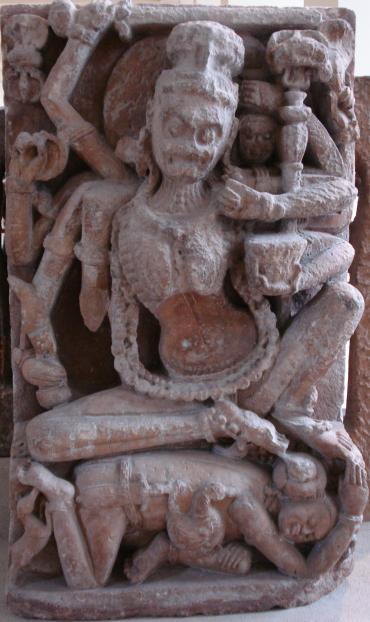
Posted in Art & Sculpture, Tradition | Leave a Comment »
| M | T | W | T | F | S | S |
|---|---|---|---|---|---|---|
| 1 | ||||||
| 2 | 3 | 4 | 5 | 6 | 7 | 8 |
| 9 | 10 | 11 | 12 | 13 | 14 | 15 |
| 16 | 17 | 18 | 19 | 20 | 21 | 22 |
| 23 | 24 | 25 | 26 | 27 | 28 | 29 |
| 30 | 31 | |||||

 भारतेन्दु
maitrEm bhajata – Guest Post by S. Aravindan Neelakandan
by Sarvesh K TiwariThere is a memorable scene in that Spencer Tracy classic “Inherit the wind” where the creationists clash with scientists in a courtroom. The pro-creationist lawyer asks the judge not to allow the testimonies of professors of zoology, archeology and anthropology in the courtroom, as they did not want to hear any “zoological hogwash” against Bible. It was déjà vu of that courtroom drama, when the Chennai based activist Radha Rajan in her recent article in the web-portal Vijayvaani.com sneered at “Anthropology, linguistics, archaeology and epigraphy” disciplines which project them as science only to provide “their peddlers the veneer of infallibility.”
The context should be first made clear. And the context is Witzel.
Professor Michael Witzel of Harvard University, Wales professor of Sanskrit was scheduled for a meeting in Sanskrit college Chennai. This created a stir, as Witzel was known for his anti-Hindu stand in the California Textbook case where he did not hesitate to derive support from anti-Indian forces. Witzel is a strong supporter of Indo-European migration model of ancient Indian past. He also favors an “illiterate Harappa” model. In all, his academic stands have a pattern: he carefully devalues, demeans and deconstructs ancient India. He does that in an academic way and sometimes his agenda spills out as he views all Indian research as naturally inferior. He smacks of western supremacist tendencies. So are some of his colleagues. So his invitation to Sanskrit college in Chennai naturally creates resentment and pain among the section of people. This is natural.
However Witzel has been criticized academically and attacked non-academically. First the academic: It should be noted that there is no textual evidence in the Vedas for Indo-Aryan migration into the Indian region. However Witzel in his work came up with one passage Baudhâyana Shrauta Sûtra. A leading international authority on Vedic Sanskrit would later comment:
Witzel also acknowledges in academic circles that his Munda, Para-Munda substratum are not as well attested by proof as he would like his lay audience to believe. For example Witzel admits in an academic paper thus:
George Cardona, an eminent linguist from University of Pennsylvania corrects many of the misconceptions that Witzel slips in between the lines in his papers. For example Witzel claims, “The spread of the narrative perfect, is a late phenomenon that it did not reach Panini at all…” Cardona states “The use of the perfect in reporting events not witnessed by a speaker is known to Panini, for his current language (Astadhyai 3.2.115…) … so that it is not precise to say “the spread of the narrative perfect …did not reach Panini at all”. (George Cardona, 2003 p.20)
In fact Cardona states in the civilized language of a venerable academician: “Without wishing to diminishing the value of Witzel’s major contribution, I have nevertheless to say that some of the conclusions and claims made are subject to doubt.” (George Cardona, 2003 p.19) Regarding one of Witzel’s pet theories on Munda substratum in Vedic language, though Cardona honestly admits he could not judge the value of the Munda vocabulary Witzel brings in, Cardona states clearly his own judgment on the Vedic terms for which Witzel proposes Munda etymology: “…although Witzel gives a long list of Vedic terms in which he sees Para-Munda prefixes, he does not, as far as I can see, give examples of entire words demonstrably borrowed from Munda and which could have served as a basis for abstracting prefixes. Moreover while asking rhetorically ‘Is the Indus language therefore a kind of Proto-Munda?’ Witzel admits, “Against this may speak first of all, as Kupier states, that the RV substrate does not have infixes like Munda.” (Emphasis not in the original: George Cardona, 2003 p.31)
The readers can note for themselves the intentional mistranslation by Witzel in order to fabricate literary evidence for Aryan migration. The readers can also note the mild language of rebuke towards the linguistic speculations Witzel puts forth with not much of credible evidence.
Now let us contradict this academic civilized culture with the way Witzel and his close associate Steve Farmer react to academic stands that go against themselves. Of course the the almost racial jabs hurled at Indians, particularly Hindus, by the learned Wales Professor of Sanskrit have made their rounds in the Internet.When in 2009 an Indian team from the Tata Institute of Fundamental Research and the Institute of Mathematical Sciences, and the Indus Research Centre of the Roja Muthiah Research Library (both at Chennai), presented a paper, resulting from more than two years of sustained research it was accepted and was published in the prestigious journal Science. The paper contradicted Witzel-Farmer thesis of “illiterate Harappans”, which they had earlier presented in a sensational way. Now this paper by Indian team proved that there is credible scientific evidence to show that the Indus script is a system of writing, which encodes a language. The derision with which the Witzel-Farmer team reacted to this paper shocked among others Iravatham Mahadevan – the famous epigraphist who has dedicated his life to study the Indus seals. He wrote:
“As they say, garbage in, garbage out,” says Michael Witzel of the Harvard University. These quotations from an online news item (New Scientist, April 23, 2009) are representative of what passes for academic debate in sections of the Western media over a serious research paper by Indian scientists published recently in the USA (Science, April 24, 2009)…. The provocative comments by Farmer and Witzel will surprise only those not familiar with the consistently aggressive style adopted by them on this question, especially by Farmer. (Iravatham Mahadevan, The Indus ‘non-script’ is a non-issue, The Hindu, May 03, 2009)
In 2001, Witzel and Farmer along with a Chennai based Marxist media establishment launched a quasi-academic media lynch of N. S. Rajaram for claiming in his deciphering of Indus script that a particular broken Indus seal as a horse. While Rajaram’s deciphering did not stand the tests of science and failed on its own merit, the mistaken identification of the seal was trumpeted by Witzel-Farmer as an intentional hoax. However N.S.Rajaram need not have had recourse to hoaxing a broken seal if he wanted to prove the presence of Equus caballus. He could have mentioned the archeological reports which place domesticated horse ca 4500 BCE at the base of Aravalli Hills (Ghosh, 1989) or at the Harappan sites of Surkatoda (AK Sharma, 1979) or nearer to his own home at the Hallur excavation (Alur 1992), or at Kalibangan (Sharma 1992-3) or at Lothal (Rao, 1979). Yet Witzel-Farmer duo went about beating their drums about how they had exposed an equivalent of a Piltdown hoax by Indian nationalists.
The truth is that had anyone bothered to apply the same standards to Witzel’s mistranslation of BSS to fabricate literary evidence for Aryan migration that could have definitely merited as a “Piltdown translation” hoax than the seal misidentification could be termed as a “Piltdown horse hoax.” Emboldened now Witzel and Farmer claim that Mahadevan had distorted the Indus seals to present it as a language. So now the Indian researches are all graded from distortions to hoaxes. Steve Farmer once spoke with the same derision about eminent Indian archeologist B.B.Lal as “rightwing archeologist” and that “absolutely none of Lal’s recent work is accepted by any leading Western archaeologist.”(In an Internet post dated January 16, 2006)
Thus the pattern that emerges is clear: Witzel and his colleague Farmer carefully devalue anything Indian and at the same time also do not hesitate to attack non-academically and in an arrogant language those who disagree with them. Interestingly, the find media-platforms provided to them. One of the reasons for their increase in non-academic, political as well as media clout is the kind of attack launched on them by a section of Hindu activists. The name-calling as well as hyperbole has helped the duo to project themselves as some sort of knights in the shining armor fighting the menacing eastern monsters threatening academic freedom and research.
This being the context let us return to the article by Radha Rajan – we will see how she unwittingly complements Witzel’s agenda b her own vitriolic language and ill-tempered statements.
So she went and insulted Mahadevan.
In her own words:
It is exactly through these kinds of moments that Witzels of the world become heroes. It is exactly because of such uncivilized attacks that we diminish ourselves. One should remember that it was Mahadevan who discovered the identification of Soma ritual and the Unicorn motif in the Indus seals. Remember that it was the Indian team under the guidance of Mahadevan that gave an academic blow to Witzel-Farmer “illiterate Harappans” hypothesis. And see how we Hindus repay him? Is it because he has provided us an opportunity to counter Witzel academically that we through our uncivilized behavior let pass.
Now to this article that Radha Rajan has penned down.
She calls archeology, linguistics and anthropology as tools for White Christian agenda. But what she forgets is that it was a white-skinned archeologist who disproved the “Massacre at Mohenjadaro” scenario – George Dales. It was an anthropologist – a white-skinned one at that- who exorcised the notion of Aryan as a racial or biological entity. It is archeologist B.B.Lal who today advocates academically the identification of Harappan civilization with Vedic. It was only a few decades back that some orthodox Hindus attacked him for his dating of core events of Ramayana as should have happened later than those of Mahabharatha. It was a white-skinned Belgian who exposed Witzel’s fabrication of literary data.
But here the malaise is deeper. Radha Rajan states that calling a discipline science a “veneer of infallibility.” This shows not just the prejudice of Radha Rajan but her ignorance about science. Had she at least customarily glanced Karl Popper she would not have written, what she had written. The label of science does not give a discipline the “veneer of infallibility.” On the other hand, it demands that the discipline should provide falsifiable hypothesis, which can be tested empirically. That is why we can claim Marxism and astrology as pseudo-sciences. That is why we can precisely identify some of the claims of Aryan invasionists and Dravidianists and their Nazi-like anti-Brahmin rhetoric as pseudo-scientific nonsense.
The readers can see for themselves that some of the worst indictments of Witzel have come from the very disciplines Radha Rajan so vehemently belittles. But it is the rhetoric of people like Radha Rajan that gives Witzel and his likes their extra-hours in the limelight of glory.
It is time Hindu intellectuals disown such uncivilized drivels and move forward and take up the challenge thrown at us by the likes of Witzel. Indian archeologists have done that. They did not indulge in word fights of street fight caliber nor did they pen down silly rhymes demeaning themselves. Rather they indulged in hard work. They overcame all the problems of a closed mindset of a dying paradigm. AK Sharma had to wait almost two decades before his discovery of horse bones were held valid. It is such Gandhian patience and intelligent hard work that will win the day for Hindus against the likes of Witzel. Instead if we abuse our own giants like Mahadevan, we are indulging in the sin of insulting Saraswati Herself.
As far Radha Rajan, I can only hope that she will not become furious reading this. A vain hope of course. For my fellow Hindu brothers and sisters I can only share with them the benedictory prayer Paramacharya wrote for UN:
maitrEm bhajata
Practice Friendship that wins all hearts
Now that is a sentiment even a die-hard Hindu atheist like myself can agree with.
S. Aravindan Neelakandan
Share:
Posted in Commentary | 16 Comments »