Archive for ‘History’

July 9, 2009

A Homosexual turned Bhakta

by Sarvesh K Tiwari

kahA kahUM ratiyA kI kathA batiyA kahi Avata hai na kacHU rI
Ayi gopAla liyo bhari a~Nka kiyo mana bhAya piyo rasa kU rI
tAhI dinA soM gaDI aMkhiyAM rasakhAni mere a~Nga a~Nga me pUrI
pai na dikhA.i parai aba bAvari dai ke biyoga bithA kI majUrI
(prema-vATikA.114)

{How do I describe that night dear, for words are escaping my tongue;
gopAla came, took me in his embrace, did what he liked, and we tasted the nectar;
And since that day, as if every pore of rasakhAn’s body has become eyes, waiting for him –
As he has not returned since, and I am left with this gift of his, this madness, this pain, this agony…}

The recent discussions on homosexuality brought to our mind that great poet of braja-bhAShA, Syed Ibrahim Piyani turned vaiShNava sAdhu rasakhAna, for whom his homosexuality itself had become the vehicle to reach kR^iShNa-devotion.

There are of course many unknown things about rasakhAna, including his parentage and early life, and we have no intentions to go into much of those details, in brief what stands almost certain from internal evidence of his own writings is that he was a homosexual, was a paThAna, used to live in dillI, and most scholars of Hindi history consider him a contemporary of Akbar. We however feel that he was an old man by the time of Akbar, and must have rather seen those times when himU had suppressed the last of Afghans and was crowned in dillI. (We have seen some hints of its mention in a couple of his lines, but that will require more analysis.)

The vaiShNava hagiography by gokuladAsa called ‘dosaibAvana vaiShNavan kI vArtA’ (Discussion on 252 vaiShNava-s) recounts the life of rasakhAna, and provides some details about rasakhAna’s homosexual beginning and how through it he turned to devotion. Reproduced below is the relevant part of the prose (#218):

“so vA dillI me eka sAhUkAra rahato hato | so vA sAhUkAra ko beTo baDo sundara hato vA cHoro so rasakhAna ko mana laga gayo | vAhI ke pIcHe phiryA karai vAko jhUTo khAve ATha pahara vAhI kI naukarI karai |… eka dina chAra vaishnava milaki bhagvadvArtA karate hate | karate karate aisI bAta nikasI jo prabhu me aisa lagAvanA jaise chitta sAhUkAra ke beta me lagyo hai…”

In summary, he used to live in dillI and been in homosexual relationship with a certain vaishya’s son, with whom he used to spend day and night and the story of their scandalous affaire was well known in the town. Once he was passing by a group of vaishnava sAdhu-s and got curious overhearing their discussion. (One sAdhu said that one must develop love for the Lord like this paThAna loves that vaishya boy). His curiosity drew him to them and when he asked he was shown a picture of kR^iShNa in shrI-nAtha form (some other descriptions mention it in muralI-manohara form, although little difference it makes). The image was so attractive that rasakhAna’s heart was immediately struck by its beauty, and he fell in love, as rasakhAna himself says in one of the dohA-s recorded in prema-vATikA: ‘prema-deva kI cHabi lakhi, bhaye miyA rasakhAna’ – one glance at the image of the Lord of Love, and miyA became rasakhAna.

He then visited vR^indAvana, and started roaming around in the company of vaiShNava vairAgI-s, eventually taking dIkShA in puShTi mata from the son of famous vallabhAchArya, composing and singing love songs for his new love, and eventually becoming the famous rasakhAna. His poems are mostly in the savaiyyA meter, and present an entirely unique strain of devotion. Above all, one can find such expressions in his work that would easily remind one of his homosexual beginnings.

It seems Moslems did not take kindly to his conversion, and some complained against him with the emperor (Akbar?), although there is no mention of any persecution of rasakhAna except for this line that he wrote: “kahA karai rasakhAna ko ko.U chugala-labAra | jo pai rAkhana-hAra hai mAkhana-chAkhana-hAra” (What harm can these petitioners bring to rasakhAna, for his protector is now none lesser than kR^iShNa himself.)

According to janaShRuti, towards the end of his life he once heard a recitation of rAma-charita-mAnasa (which must have been composed just recently by young tulasIdAsa), and took to its reading and hearing very lovingly.

His immortal, famous last-wish:

mAnusa hauM tau vahI rasakhAna basauM mili gokula gaoM ke gvArana
jo pasu hauM tau kahA basu mero charauM nita nanda kI dhenu majhArana
pAhana hauM tau vahI giri kau jo dharyo kara cHatra purandara kArana
jo khaga hauM tau basero karauM mili kAlindI kUla kadamba kI DArana

(If reborn as a human, then wish to be reborn as rasakhAna, living among those shepherds of gokula;
And if I have to be reborn as an animal, for what control do I have in it, then wish to be born as a cow that would graze together with the cows of nanda;
And if I be sent as a stone, then let me be on that hill, which my Lord picked up due to the wrath of purandara;
And if I become a bird, then I wish I shall make home on the branches of those kadamba trees that grow on the banks of holy yamunA)

bhAratendu records about rasakhAna in his uttara-bhaktamAla, and counting him among other moslem-turned-Hindu devotees, he ecstatically concludes: “ina musalmAna harijanan pai koTina hinduna vAriye”: (the gain of such hari-jana musalmAns makes cheaper to me the loss of a million Hindus.)

July 6, 2009

A Ghazi turned Kafir: the Case of Akbar’s U-Turn – 5

by Sarvesh K Tiwari

continues from Part-1, Part-2 , Part-3, Part-4

While we have sufficient data about Akbar’s U-turn from the onwards of year 1576-77, that is generally coinciding with the time from which the Shiites got engaged, and the process stands fairly coherent after the year of 1580-81 when Akbar was done with the religion of the Prophet, our knowledge is woefully challenged by the insufficiency as well as lack of satisfactory clarity of data available about the happenings in the neighborhood of 1575-76. We are left only with badAyUnI narrating for us the events from this initial stage of the process, without the benefit of corroboration either from the IsAists or the informants of the dabistAn’s author.

We have already seen that down to this time Akbar was under major influence of the sUfI-s, originally of the naqshabandiyA variety but for many years now of their chishtI cousins. A couple of disconnected anecdotes narrated by badAyUnI reinforce our information on how deeply was pAdishAh biased towards chishtiA. One of these days when blessed with a son, badAyUnI approached him for choosing a name for the newborn as per the custom, and the name Akbar proposed, ‘abdal hAdI’, indirectly reveals his bend at the time: ‘hAdI’ being a common address to the sUfI masters. [1]

Another anecdote about name-giving confirms the same. After fulfilling his pious desire of participating in jehAd against Hindus at haldIghATI, badAyUnI returned to sIkarI in the end of 1576 with an accidentally captured elephant of mahArANA, dispatched for Akbar by Man Singh. When Akbar was told that mahArANA called it ‘rAma-prasAda’, he rechristened the war-elephant as ‘pIra-prasAda’, the ‘Grace of pIra’, referring by pIra the chishtI of ajmer. [2] (If name-giving could be any indicator of Akbar’s religious bend at any given time, then it is very interesting to note that during his later life the names Akbar gave to the newborns, for instance to the son of abul-fazl, or to his own grandsons, were all non- or pre-Islamic.)

At another instance, Akbar scoffed at a sUfI divine for having reportedly criticized the chishtI master, by saying: ‘Hazrat Khwaja Muinuddin Chishti is my preceptor… Anyone who says that he was misguided (gumarAha) is a kAfir, and I shall slay that person with my own hands.’[3] Indeed, by this time, he was a committed follower of chishtiA, not only regularly visiting the dargAhs of the chishtI sheikhs but actually practicing their peculiar exercises.  badAyUnI reports that sometime around 1576, Akbar went so far as to learn and attempt the performance of chillA-i-makus, sort of a penance in which one suspends one’s head downwards in a well for forty days while continuously meditating. [4]

His strong bias towards the sUfI-s must certainly have been playing an important role at ibAdat-khAnAh in this crucial initial phase, and to understand the likely dynamics better, we are forced to take an unavoidable digression into the position of sUfI-s within the scheme of Islam. In the infancy of Islam there was hardly any need for either philosophy or mysticism. Its spirit was not concerned with these trivialities as it erupted forth from Arabia, the basic and the only demand it placed before the convert was the absolute acceptance and obedience to the revealed command of Allah, rather than explaining, understanding or putting it to reason, which was not only unnecessary but also implicitly impossible. Within this worldview, as the ultimate scope of human knowledge was limited to knowing Allah and His Law as revealed by the Prophet, it permitted the intellectual and spiritual pursuits only as far as they develop a deeper piety and belief in the revelation. However, by the mid of the next century even as the sword of Islam defeated and subjugated vast domains of the non-Islamic societies, it had to be confronted with the sophisticated ancient religions not on the battlefields anymore but now on the turfs of philosophy and theology, and had to soon recognize the crisis of its own poverty in these fields.

The realization necessitated the Moslems to systematize and develop somewhat more rational explanations of their theology, by desperately though reluctantly employing, like their Christian cousins had done before them, service of the Greek logic and system of rational disputation, while of course scornfully distilling out all the heathen thought that came with it. By unscrupulously utilizing the heathen system of ration for template and Qoran and the life of the Prophet as data, Islam began filling the void that was there in it concerning the finer points of theology like the nature and attributes of Allah, scope of revelation, free-will versus the pre-destination etc., thus the proper founding of Islamic orthodoxy and rise of the famous lines of jurists: abU hanIfA (d 767), mAlik ibn-anas (d 795), ash-shafi-I (d 820), and ahmed ibn-hanbAl (d 855). The new faculty inaugurated the careers for the custodians of Islamic orthodoxy and guardians of the new theology, who would systematize every fine point about theology, government, law and society of Islam.

While on one hand Islam was pressurized to develop the system of its orthodoxy, in the east it was staring at another and more profound crisis. Its newly conquered territories in east – the north-eastern IrAq and interior Persia, Turkey and Caucasus – were homes to several of the immensely rich and ancient Indo-Iranian-Greek mystic and monastic traditions, answer to which the invader did not know besides trying to wipe out the kufr and jAhiliyyA by brute force as it had done back home. Unlike what it encountered in west however, where the ground was already prepared for it by the very compatible Christian creeds, here Islam had to grapple with a whole different reality. Even after simply eliminating the monks and the mobeds, demolishing the monasteries and the fire-altars, the pious invader could only succeed in converting these people in letter but not so much in spirit. The new convert continued to apply counter-pressure and bring with him his ancient mystic spirit and traditions, to the new religion forced upon him. The reaction from the guardians of the purity in Islam was on the predictable lines: suppression of heresy through persecutions, which applied selective pressures on the native traditions and their followers, culminating in survival of those traditions which managed to learn how to adjust themselves and survive within the limits permissible in Islam, and these are who would later give birth to the sUfIs. It is no surprise to observe that the earliest illustrious sUfI-s were the children of the jaruthastrian converts to Islam, like bAyazId bastAmI (d 874) and mansUr al-hillAj (publicly executed 922) etc., although western sUfIlogists and apologists of Islam carefully conceal this fact.

Thus the making of the sUfI, which started in the ninth century but did not complete until the twelfth, the process involving gory persecution at the hands of ulemA and khalIfA, and resulting over time in circumspection and internalization of Islam by these mystics, causing them to make inventions of historically-impossible vaMshAvalI-s in order to link themselves to the Prophet and his companions (sometimes explaining these linkages using supernatural travels, spiritual visions, or appearances in dreams), liberal applications of hagiography to absorb the historical Moslem figures as saints of their own traditions, interpreting Qoranic verses and Prophetic traditions to seek approvals for their practices, adopting Arabic terminology to express their spiritual ideas (until a limited later revival of local vernaculars), and above all, forcefully de-linking themselves from their true origins. Then there was also an element of the pre-Islamic mysticism of Arabia finding a renewed channel to express itself once again too.

 Our present scope would prevent us from delving much deeper into this process, and the matter need not detain us further than saying that Islam dealt with the crisis of its mystic poverty by ruefully allowing some liberty to the mysticism of the converts, as long as they did not clash with the core of Islam, as Sita Ram Goel writes: “…the sufi spirit was irrepressible like all other sterling expressions of the human spirit. But theology and theocracy were equally uncompromising. After a lot of terror inspired by theologians and theocrats, a compromise was made between the two… The sufis could sing and dance and indulge in other ‘frivolities’ provided they swore by the Muhammad, conformed to the Sunnah in their outer conduct, and served the sultans in the extension of Islamic imperialism.”[5]

Their islamization was to however complete soon, and whatever the origins of their real traditions, the later sUfI-s came down to become zealous missionaries of Islam, often displaying no lesser bigotry than the orthodox ulemA. Their role now started to come handy for both before and after the march of jehAd into undefeated dAr-ul-harb: before, as one writer perceptively states, as “the sappers and miners of the invading Muslim armies”, and after, as “a balm to the insulted, humiliated and the plundered” kAfirs[6].  They now played no small role in both converting the defeated kAfir as well as in preventing the neo-converts from falling back to their original faiths. Proverbially, the sword of sultan took the horse up to the water and sUfI-s made him drink it, whereas eventually the ulemA would take over and indoctrinate the coming generations of the neo-convert into Islam-proper.

The ulemA, the sultAn and the sUfI, now acted as if three columns of the vanguard of Islam, but like the three generals, while they acted in unison at war, internally they wrestled for supremacy over the other; the sUfI claiming to be the spiritual heir of the Prophet and his living model in this world, ulemA concerned with the preservation of the purity of the true faith as revealed, and the sultAn of course being the champion of Islam and its Rightly Guided khalIfA. The tussle between them can be noticed throughout the history of Islam, and is evident even before Akbar, during the tug of war between alA-ud-dIn khaljI, his contemporary orthodoxy, and nizAm-ud-dIn the chishtI awliyA of dillI. This process can also be noticed in the eighteenth century Arabia where the sa’Ud sultan and abdal wahhAb the ulemA would forge an alliance to subjugate the sUfI and ‘reform’ the Islamic faith. But despite the internal tussle, whenever the three resonated together in concordance, they imploded into the Islamic Revolution, as can be witnessed from the times of the Caliphs to the times of awrangzib the naqshbandiyA sUfI, down even to the revolution of AyAtollAh khomeinI or of the tAlibAn the pious deobandists.

In any case, what we are witnessing at the present moment in Akbar’s decision to hold theological discussions is, in our opinion, springing from this inherent schism between the sUfI-s and the Islam. Akbar was compelled to pay attention to it, he himself being inclined to the sUfI-s at heart but towards orthodox Islam in mind, as we can understand from this statement of badAyUnI: “pAdishAh has thus leisure to come into nearer contact with ascetics and the disciples of his reverence, muin, and passed much of his time in discussing QorAn and hadIs. Questions of Sufism, scientific discussion, enquiries into Philosophy and Law, were the order of the day. His Majesty spent whole nights in praising Allah; he continually occupied himself in pronouncing yA-huwA, and yA-hAdI, in which he was well-versed.” [7]

It would appear natural for such a pious follower of sUfI tarIqA to try and arbitrage a truce between sUfI-s and orthodoxy, maybe help develop a synthesis as had happened earlier outside India, for right at the moment orthodoxy was once again inspiring much terror into the sUfI-s and as we have seen the persecutions of heretics was the order of the day.

continued…

1. Muntakhab ut-tawArikh, Vol. II, p229 (Incidentally, not unusual for the then prevailing infant mortality, the child was soon consumed by some fatal sickness, but in retrospect badAyUnI accuses himself, lamenting why he succumbed to the heretical ways of pAdishAh rather than bringing home his orthodox colleagues to recite QorAn to seek blessings for the newborn.)

2. Muntakhab ut-tawArikh, Vol. II, p243

3. Majalis, Maktaba Ibrahimia, #1367 p. 58. Quoted from IQTIDAR ALAM KHAN,”Akbar’s Personality Traits and World Outlook: A Critical Reappraisal”, Aligarh Muslim University – Center of Advanced Study in History

4. Muntakhab ut-tawArikh, Vol. II, p. 201 and vol. III p. 110. Akbar learnt it from a dervish Shaikh Chaya Laddha but did not perform it.

5. Sita Ram Goel, “Starting Point of Universal Spirituality”, Defence of Hindu Soceity, Voice of India

6. Ram Autar Singh, Time for Stock Taking, Voice of India, 1996

7. Muntakhab ut-tawArikh, Vol. II, p. 203

Tags:
June 12, 2009

bhUShaNa: chaNDI grows fat!

by Sarvesh K Tiwari

dADhi ke rakhaiyan kI DADhi sI rahati cHAti bADhI marjAda jasa hadda hinduvAne kI!!
kaDhi gaI raiyati ke mana kI kasaka saba miTi gaI Thasaka tamAma turakAne kI!!
bhUShaNa bhanata dilIpati dila dhakadhakA suni suni dhAka sivarAja mardAne kI!!
moTI bhayI chaNDI binu-choTI ke chabAya sIsa khoTI bhaI sampati chakatA ke gharAne kI!!

Chests of the bearded fellows burn like bonfire, such now are growing the bounds of the Hindu Nation!!
Hopes of people are all answered, such is being demolished the vainglory of the turuShka-s!!
bhUShaNa says this hearing the hartbeat of the dillI-king in awe of shivA the manly —
Overfed chaNDI grows fat chewing the shikhA-less heads, and lays in waste the wealth of the house of chakatA (moghuls)!!

veda rAkhe vidita purAna rAkhe sArayuta rAmanAma rAkhyo ati rasanA sughara mai!!
hindun kI choTI roTI rAkhI hai sipahiyan kI kAndhe mai janeu rAkhyo mAlA rAkhI gara mai!!
mIDi rAkhe mugal maroDa rAkhe pAtasAh bairI pIsi rAkhyo varadAna rAkhyo kara mai!!
rAjan kI hadda rAkhI tega bala sivarAja deva rAkhe devala svadharma rAkhyo ghara mai!!

Protected the veda-s renowned, and the essence of purANa-s, keeping the name of rAma at your worthy tongue;
Protected the shikhA of Hindus, and empoy of the warriors, keeping yaj~nopavIta on your shoulder and a mAlA in neck;
Kept mughals wrenched, pAtishAha writhed, and crushed all enemies, with the divine-boon in your hand;
Blessed be you and empowered your sword O shivarAja rAjan, that the deities are protected in temples and swadharma in homes.

June 10, 2009

bhUShaNa’s characterization of different nations

by Sarvesh K Tiwari

jora rusiyAna ko hai tega khurAsAna hU kI
nIti inglaNDa chIna hunnara mahAdarI
himmata amAna maradAna hinduvAnahU ko
rUma abhimAna habasAna-hada kAdarI
nekI arabAna sAna-adaba IrAna tyo hI
krodha hai turAna jyo pharAnsa phanda-AdarI
bhUShaNa bhanata imi dekhiye mahItala pai
vIra-siratAja-sivarAja kI bahAdurI
(BG.482)

Russians are as renowned for strength as khorAsAnians are for swordsmanship;
English suppress all in shrewd strategizing and Chinese in engineering;
But, it is by valour and manliness that Hindus distinguish themselves;

If Romans were known for their pride and glory, Ethiopeans are for timidity,
Arabs are for piety and Iranians for their courtesy and grace;
Turks are known for their uncontrolled wrath, and French for their intrigues and conspiracies
bhUShaNa has seen these different people on this earth
But found no match to compare with the bravery of shivAjI, the crown-jewel of bravery itself!

1. In listing Hindu as a nationality, along with English and French, Chinese and Russian, Turks and Iranians, it is clear that bhUShaNa is reflecting the contemporary consciousness of a Hindu-Nationhood and self-identity, which flies in the face of those who propose the perverted argument of Indian Nationhood being a post-British construct.

2. Are these attributes of people that he mentions, mere rhetoric of poetry, or is there any real sense that bhUShaNa felt about those? French for hatching conspiracy, and English for strategizing!!

Tags: ,
May 23, 2009

Hindus’ delusion – Be like a cow or like gajAshvavR^iShabha

by Sarvesh K Tiwari

Travels have kept us from continuing with the case of Akbar’s U-Turn, which hopefully we shall soon resume. 

In the meanwhile it seems the hindU-dviTa-s will continue to rule and subvert the hindu nation, allowing unmitigated AtAtAyins to resume their centuries-old enterprise.  The self-appointed custodians of so-called hindutva are seen biting dust and licking their wounds.

While none of this came as any surprise to us, and we half-expected exactly this outcome, what is astonishing is to see the foolish Hindu now getting over his disappointment, and after a phase of shock and denial, going back to his old habits.  He seems prepared to learn no lessons, and in his delusion or blindness continues to behave like the docile and sluggish cow that he worships; who tied by the neck and driven to slaughterhouse by the vadhika effortlessly, does not so much as bray leave aside resist if not revolt!

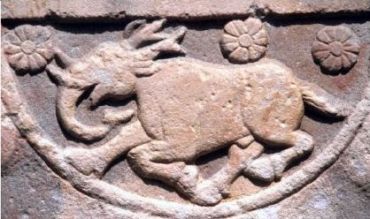
We can only remind the dying Hindu how his brave and manly forefathers saw themselves. This 1st century sculpture from madhya-desha depicts the self-identity of those gallant men, through an intriguing admixture of three most manly creatures they knew from their social life: ashva, gaja and vR^iShabha.  All mixed into an inseparable whole: the Horse, swift, steady and full of vitality; the Elephant, powerful, fearless and invincible; the Bull, full of virility, and of untiring enterprise!

gajAshvavR^iShabha

This is how the Hindu of that age saw himself, and more than then, this is how his progeny has to behave today if they desire to at least put up a meaningful front in the ongoing existential battle for survival in the very homeland of their grandfathers.

April 22, 2009

A Ghazi turned Kafir: the Case of Akbar’s U-Turn – 4

by Sarvesh K Tiwari

continues from Part-1, Part-2 , Part-3

The year is 1574 from where we have to pick up the threads of this phase of our story.

Akbar is by now in control over a vast portion of North India, his writ reigning unchallenged from sindhudesha in west up to major parts of va~Nga in east, and from the foothills of himAchala in north up to the boundaries of marahaTTA country in south. The momentum of his imperialist campaign for expansion is now such that the next few years would see him delete the sovereignty of most prevailing kingdoms of India, some with physical military subjugation while others simply bullied into suzerainty, barring remote regions of coastal dakShiNApatha and prAgjyotiSha.

The only exception to this is mewADa, right in the heart of Akbar’s conquered domains, where a saffron banner continues to defiantly kiss the sky, decorated with its golden emblem of the sun and the moon looking over a cow feeding her calf. Pratap Singh Sisodiya the mahArANA neither budges to diplomacy nor is Moghal army able to overpower him militarily. In frustrating every advance of Akbar, he is more than matching imperialist resourcefulness with his single-minded grit and valiance of his dedicated followers. His insignia now includes a nAgarI line in brajabhAShA that more than defines the tumultuous struggle of mewADa: “jo dR^iDha rAkhahin dharama kau tAhi rakhahi kartAr” (Those who are stiff in protecting dharma, are looked after by the Creator). mahArANA remains the chief focus of Akbar’s hostility, the hallmark of which, the bloodbath of haldIghATI is a couple of years out in the future (1576).

Within dAr-ul-islAm Akbar is now considered one of the most powerful monarchs, if not the most, and his name is well known in Mecca, where he sends rich gifts with every contingent of hAjI-s from India. (There is an interesting account that gulbadan has left in her diary, of how when one of these days a fleet of Indian hAjI-s reached Mecca, of which she was a part, it caused a minor riot of sorts among Arabs who had gathered there to receive the presents sent by Akbar.) Arabian world is controlled from Constantinople by the Sultanate of the osmAnI turuShka-s, who are now fast receding in strength, thanks to the continuing push from the Christian west and to some extent the Shi’aite east. The then khalIfA, Murad the third, can measure up to Akbar only on one account, that is, the population of the harem.

Another major bloc in the Moslem world, the usbec-tAjiks of bukhArA are while no match to Akbar’s power, they are kept in good humour by him with diplomacy, since their co-ethnics still form a significant column of his military, and he needs to temporarily maintain peace at North-West to consolidate his conquered inner domains, otherwise his desire of rooting out the very seed of usbecs from the soil of India is well-known. For Akbar the real competition for dominance in islAmosphere is from the safAvI-s of Persia, whose great ruler shah tahmAsp is now in his advanced years, at whose court once humAyUn was sheltered as a political refugee at the time when Akbar was entering this world. shAh is destined to depart in a couple of years (1576), and is imitated by Akbar in many respects including the language policy, army regimentation, administrative structure, even in the numismatic designs. This is also largely because Akbar is continuously importing from Persia a majority share of his employees.

Indeed moslems are now flocking to Akbar’s capital from every known quarter of dAr-ul-islAm, mostly the nobles and mercenaries, scholars and artists, in lure of the blooming career opportunities. There is an interesting account in A’in that informs us of how Akbar conducted job interviews of these prospects, checked their references and fixed their compensations. One of the side-effects that this in-migration has resulted in, of importance to our topic, is that under Akbar are accumulated moslems of a variety of sects loathing each other as heretics and living in sectarian animosity.

There are Hindus too in his service, although their numbers making for a small minority. Some Hindus have reached quite higher up in his civil administration, like Todarmal, as well in military, like Man Singh Kachhwaha, besides some having gained his personal friendship, like Birbal. Such Hindus are joked about by mullAh-s, as kAfIrs spreading the reach of Islam. badAyUnI proudly reports in 1576: “Through the generalship of Man Singh the true meaning of this line of mullA shIrI became known, ‘A Hindu wields the Sword of Islam’ ” [4.1]

The imperial capital has been relocated to sIkarI, a few miles interior from Agra, and renamed as fatehpur the ‘City of Victory’. The selection of new capital is a decision driven largely by reverence to the sunnI sUfI sheikh salIm the chisht, who used to have his khAnakAh here, which is now flourishing under royal patronage while the sUfI himself has departed for Allah’s abode a couple of years back (d1572).

Although there are plenty of political matters that need considerable attention of Akbar at the moment – putting down this rebel here and attending to some other feud there – but things are a lot more stable while the empire is already consolidating, and Akbar can more or less remotely manage these affairs from his new capital.

Earlier concerns related to being childless are not bothering Akbar anymore, who now has two daughters and three princes, while another child is on the way. Salim born from the rAjapUtAnI wife is now five, whereas Murad and Daniyal born from two concubines are toddlers of four and two.

Having found some respite from politics and being relatively trouble-free, he now has the opportunity of turning to other priorities.

Year 1574 therefore, the thirty-third year of his life, marks the inauguration of the study of Islam by the Great turuShka.

badAyUnI’s take for 1574: “In the course of the last few years, pAdishAh has gained many great and remarkable victories, and his domain has grown in extent from day to day, so that not an enemy is left in the world; he now takes a liking for the society of ascetics and the disciple of the celebrated Mu’iniyyah (i.e. the cult of chisht), and spends time in discussing the Word of God (i.e. Qoran) and the sayings of the Prophet.” [4.2]

To make his enterprise of studying his religion as grand as any other, Akbar commissioned building of a complex dedicated to this sole purpose and named it ibAdat-khAnAh, the ‘House of Prayer’, along with a large lake in its annex which he named as anUpa tAlAba the ‘Lake without a Simile’. This construction would be ready for inauguration by fall in next year.

Let us note in the passing that while all other monuments mentioned in the histories of Akbar can be seen to this day at sIkarI, there is not one sign of ibAdat-khAnAh nor of anUpa-tAlAba, which are otherwise so well described not only in several independent chronicles but also depicted on portraits by contemporary painters. The entire complex has simply vanished, as if evaporated from the surface without leaving any trace. While there is no record of what happened to it, we have very little difficulty in suggesting that its disappearance has to do with the revenge of the believers, and it is more than likely that jehAngIr himself might have ordered its demolition to erase out the physical memorabilia of where his father shed from himself the religion of the Prophet. Little else explains the complete disappearance of ibAdat-khAnAh from sIkarI.

We may call it an act of fate or just a coincidence, but at the same time when ibAdat-khAnAH is under construction, an important agent makes its entry in the process. Sheikh abul-fazl allAmI, the author of A’in-i-akbarI joins in 1574 the clerical staff of Akbar’s secretariat, and little does Akbar know that abul-fazl is to eventually become a guide and a fellow traveler of the journey that has begun, and finally its martyr. abul-fazl’s efficiency would soon see him rise from being a technical-writer to first head the federal secretariat and finally as vizIr of the empire. Being a son of a renowned philosopher-scholar of the age, sheikh mubArak nAgaurI, condemned by orthodox moslems as a heretic but pardoned by Akbar due to some recommendations, abul fazl has thoroughly studied not only the doctrines of different sects within Islam, is trained in critical thought, but has also gained some knowledge about religions and philosophies that Islam has wiped out and is sympathetic towards those. Although only a youth in his early twenties, he would soon be discovered by Akbar as a budding scholar of Islam whom seasoned mawlAnA-s find hard to match both in eloquence as well as in knowledge.

What could be a more bizarre stroke of good fate than this that this year also coincides the beginning of our chief informant getting deployed at the scene, mullAh abdul qAdir badAyUnI. badAyUni, a pious young mullAh, is appointed in the summer of 1574 at the post of assistant shAhI imam of the royal mosque, and he does this crucial assistance to us by recording the events we are interested in, through this hobby of his of maintaining a private diary-like journal. This would eventually become the copious muntakhabut-tawArIkh, which is a very rich repository of data for us to learn about this process, especially because to a fundamentalist musalmAn like badAyUnI it would come intuitively to focus closely on the process of pAdishAh turning an apostate. Not only did badAyUnI have considerable access to Akbar’s religious life during this phase, and was privy to his words & deeds from up close, but what is even more important is that he wrote this chronicle as a private work not intended for others eyes in his lifetime. This way, we can take him to be free from considerations of flattery and other influences. Indeed he does not hesitate in openly cursing, condemning, even using expletives for what his moslem heart can not approve of. tawArIkh reaches us because Akbar remained unaware that under his nose badAyUnI was secretly writing it, and it came to light only during jehAngIr’s reign, who then attempted to purge its very existence by confiscating and destroying its every copy. Thankfully, tawArIkh had been copied and circulated more widely and unlike ibAdat-khAnAh it survives today to bear witness to Akbar’s U-turn.

In addition to tawArIkh, also of assistance to us are the reports and dispatches left behind by the Portuguese Jesuits, who had gleefully arrived for converting the ‘Great Mogor’, from Goa where right at the moment their co-religionists were busy in one of the bloodiest heathen-wipeouts outside of kraunchadvIpa.

But the most useful source for the proceedings of ibAdat-khAnAh, including a bit dramatized transcripts of some debates, comes to us preserved by the pArasIka refugees who being persecuted at the hands of Moslems in their homeland had fled from Persia to settle down in gujarAta province which has just joined the list of Akbar’s conquests. We know that a learned pArasIka scholar and community leader dastUr meherjI rANA had arrived at Akbar’s court from gujarAta a little later from now, and had left Akbar bedazzled both with his wisdom and arguments as well as by the history he had narrated of how Islam had subjugated the glorious Persia and persecuted his ancestors.

A younger contemporary of learned dastUr rANA was kai-khusaru esfandiyAr, who was the son of dastUr’s master the jaruthastrian high priest of Fars, named Azar-kayvAn. esfandiyAr later undertook to study all the sects prevailing in India, with help of his brAhmaNa friends and by visiting monasteries from kashmIra to Andhra. The output was a significant Persian work on comparative study of religions, titled dabistAn-i-mazahab, compiled between 1630 and 1657 that is roughly during shAhjahAn’s time. This work is significant to our subject, because it not only dedicates a complete chapter to the cult of Akbar, but under it also provides a separate section to record the transcripts of ibAdat-khAnAH sessions, from the oral traditions of some ilAhIans, pArsIka-s and Shiites.

Generally our historians shrug this data aside as hearsay or hagiography since it was compiled at least four decades after the event. But we are of the opinion that even if allowing that some dramatizations or exaggerations have been utilized by the author in presenting the transcripts, what stands absolutely certain is that the chronologically relative flow of themes of debates as well as the main points under them, are extremely close to actual happenings. This is because there is near-absolute conformity of it with other independent chronicles: that of badAyUnI and of the Christists. Indeed it is comforting to observe that the descriptions of some of the debates are so close with the accounts by Christists – and dabistAn’s author had no access to the Jesuit reports dispatched to Goa and thence to Europe – that we can safely consider the data in dabistAn being closer to reality and can use it here with some care and due diligence.

The most disappointing to us is the response of the Hindus to this event.

Having commented that Hindus produce great philosophers but horrible historians, Max Muller remains a hated figure among large sections of Hindus of our time. But how do we escape from agreeing with Muller’s observation in context of our subject when we are faced with complete silence from Hindus on the subject of Akbar’s U-Turn? There is no records kept by Hindus who watched the event from close, aside from some glorifications in jaina chronicles like vijaya-prashasti or in the vulgar poetries of the bhATs of rAjasthAn.

We do know that brAhmaNa-s had not only participated in the debates but had the foresight of collaborating well among like-minded, the shvetAmbara-s and the nAtha-yogI-s, and had indeed fared very well in the debates. Their performance evokes much disappointment from badAyUnI who is forced to admit that Hindus are superior philosophers and disputers than his own co-religionists: “Hindu ascetics and Barhmans… suppress all other learned men in their treatises on morals and on physical and religious sciences, and since they attain a high degree of knowledge of the future and of spiritual power and human perfection, they managed to bring proofs based on reason and testimony for the truth of their own religion and falsity of other faiths, and inculcated their doctrines so firmly that no man, by expressing his doubts, could raise a doubt in pAdishAh, even though the mountains should crumble to dust or the heavens be torn asunder.”[4.3]

Why did then Hindus not take care to record any of these happenings? Why did they fail to recognize and record the watershed event taking place before their eyes which had the potential of changing the course of history, indeed as it actually might have? What stopped the Hindu scholars from making critical assessment of the doctrines of invading religions, until dayAnand saraswatI did so in the nineteenth century?

But we digress, and must return to 1574-5 where stage is set and Akbar has now accumulated the best known sunnI scholars of his time. He is now spending with them at least a couple of evenings in each week to hear them discuss among themselves and with him the tenets of Islam, discussions moderated by none other than himself.

continues… part 5
Tags:
Design a site like this with WordPress.com
Get started