June 12, 2009

bhUShaNa: chaNDI grows fat!

by Sarvesh K Tiwari

dADhi ke rakhaiyan kI DADhi sI rahati cHAti bADhI marjAda jasa hadda hinduvAne kI!!
kaDhi gaI raiyati ke mana kI kasaka saba miTi gaI Thasaka tamAma turakAne kI!!
bhUShaNa bhanata dilIpati dila dhakadhakA suni suni dhAka sivarAja mardAne kI!!
moTI bhayI chaNDI binu-choTI ke chabAya sIsa khoTI bhaI sampati chakatA ke gharAne kI!!

Chests of the bearded fellows burn like bonfire, such now are growing the bounds of the Hindu Nation!!
Hopes of people are all answered, such is being demolished the vainglory of the turuShka-s!!
bhUShaNa says this hearing the hartbeat of the dillI-king in awe of shivA the manly —
Overfed chaNDI grows fat chewing the shikhA-less heads, and lays in waste the wealth of the house of chakatA (moghuls)!!

veda rAkhe vidita purAna rAkhe sArayuta rAmanAma rAkhyo ati rasanA sughara mai!!
hindun kI choTI roTI rAkhI hai sipahiyan kI kAndhe mai janeu rAkhyo mAlA rAkhI gara mai!!
mIDi rAkhe mugal maroDa rAkhe pAtasAh bairI pIsi rAkhyo varadAna rAkhyo kara mai!!
rAjan kI hadda rAkhI tega bala sivarAja deva rAkhe devala svadharma rAkhyo ghara mai!!

Protected the veda-s renowned, and the essence of purANa-s, keeping the name of rAma at your worthy tongue;
Protected the shikhA of Hindus, and empoy of the warriors, keeping yaj~nopavIta on your shoulder and a mAlA in neck;
Kept mughals wrenched, pAtishAha writhed, and crushed all enemies, with the divine-boon in your hand;
Blessed be you and empowered your sword O shivarAja rAjan, that the deities are protected in temples and swadharma in homes.

June 10, 2009

bhUShaNa’s characterization of different nations

by Sarvesh K Tiwari

jora rusiyAna ko hai tega khurAsAna hU kI
nIti inglaNDa chIna hunnara mahAdarI
himmata amAna maradAna hinduvAnahU ko
rUma abhimAna habasAna-hada kAdarI
nekI arabAna sAna-adaba IrAna tyo hI
krodha hai turAna jyo pharAnsa phanda-AdarI
bhUShaNa bhanata imi dekhiye mahItala pai
vIra-siratAja-sivarAja kI bahAdurI
(BG.482)

Russians are as renowned for strength as khorAsAnians are for swordsmanship;
English suppress all in shrewd strategizing and Chinese in engineering;
But, it is by valour and manliness that Hindus distinguish themselves;

If Romans were known for their pride and glory, Ethiopeans are for timidity,
Arabs are for piety and Iranians for their courtesy and grace;
Turks are known for their uncontrolled wrath, and French for their intrigues and conspiracies
bhUShaNa has seen these different people on this earth
But found no match to compare with the bravery of shivAjI, the crown-jewel of bravery itself!

1. In listing Hindu as a nationality, along with English and French, Chinese and Russian, Turks and Iranians, it is clear that bhUShaNa is reflecting the contemporary consciousness of a Hindu-Nationhood and self-identity, which flies in the face of those who propose the perverted argument of Indian Nationhood being a post-British construct.

2. Are these attributes of people that he mentions, mere rhetoric of poetry, or is there any real sense that bhUShaNa felt about those? French for hatching conspiracy, and English for strategizing!!

Tags: ,
May 23, 2009

Hindus’ delusion – Be like a cow or like gajAshvavR^iShabha

by Sarvesh K Tiwari

Travels have kept us from continuing with the case of Akbar’s U-Turn, which hopefully we shall soon resume. 

In the meanwhile it seems the hindU-dviTa-s will continue to rule and subvert the hindu nation, allowing unmitigated AtAtAyins to resume their centuries-old enterprise.  The self-appointed custodians of so-called hindutva are seen biting dust and licking their wounds.

While none of this came as any surprise to us, and we half-expected exactly this outcome, what is astonishing is to see the foolish Hindu now getting over his disappointment, and after a phase of shock and denial, going back to his old habits.  He seems prepared to learn no lessons, and in his delusion or blindness continues to behave like the docile and sluggish cow that he worships; who tied by the neck and driven to slaughterhouse by the vadhika effortlessly, does not so much as bray leave aside resist if not revolt!

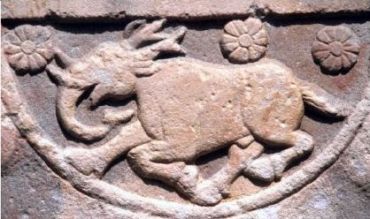
We can only remind the dying Hindu how his brave and manly forefathers saw themselves. This 1st century sculpture from madhya-desha depicts the self-identity of those gallant men, through an intriguing admixture of three most manly creatures they knew from their social life: ashva, gaja and vR^iShabha.  All mixed into an inseparable whole: the Horse, swift, steady and full of vitality; the Elephant, powerful, fearless and invincible; the Bull, full of virility, and of untiring enterprise!

gajAshvavR^iShabha

This is how the Hindu of that age saw himself, and more than then, this is how his progeny has to behave today if they desire to at least put up a meaningful front in the ongoing existential battle for survival in the very homeland of their grandfathers.

April 22, 2009

A Ghazi turned Kafir: the Case of Akbar’s U-Turn – 4

by Sarvesh K Tiwari

continues from Part-1, Part-2 , Part-3

The year is 1574 from where we have to pick up the threads of this phase of our story.

Akbar is by now in control over a vast portion of North India, his writ reigning unchallenged from sindhudesha in west up to major parts of va~Nga in east, and from the foothills of himAchala in north up to the boundaries of marahaTTA country in south. The momentum of his imperialist campaign for expansion is now such that the next few years would see him delete the sovereignty of most prevailing kingdoms of India, some with physical military subjugation while others simply bullied into suzerainty, barring remote regions of coastal dakShiNApatha and prAgjyotiSha.

The only exception to this is mewADa, right in the heart of Akbar’s conquered domains, where a saffron banner continues to defiantly kiss the sky, decorated with its golden emblem of the sun and the moon looking over a cow feeding her calf. Pratap Singh Sisodiya the mahArANA neither budges to diplomacy nor is Moghal army able to overpower him militarily. In frustrating every advance of Akbar, he is more than matching imperialist resourcefulness with his single-minded grit and valiance of his dedicated followers. His insignia now includes a nAgarI line in brajabhAShA that more than defines the tumultuous struggle of mewADa: “jo dR^iDha rAkhahin dharama kau tAhi rakhahi kartAr” (Those who are stiff in protecting dharma, are looked after by the Creator). mahArANA remains the chief focus of Akbar’s hostility, the hallmark of which, the bloodbath of haldIghATI is a couple of years out in the future (1576).

Within dAr-ul-islAm Akbar is now considered one of the most powerful monarchs, if not the most, and his name is well known in Mecca, where he sends rich gifts with every contingent of hAjI-s from India. (There is an interesting account that gulbadan has left in her diary, of how when one of these days a fleet of Indian hAjI-s reached Mecca, of which she was a part, it caused a minor riot of sorts among Arabs who had gathered there to receive the presents sent by Akbar.) Arabian world is controlled from Constantinople by the Sultanate of the osmAnI turuShka-s, who are now fast receding in strength, thanks to the continuing push from the Christian west and to some extent the Shi’aite east. The then khalIfA, Murad the third, can measure up to Akbar only on one account, that is, the population of the harem.

Another major bloc in the Moslem world, the usbec-tAjiks of bukhArA are while no match to Akbar’s power, they are kept in good humour by him with diplomacy, since their co-ethnics still form a significant column of his military, and he needs to temporarily maintain peace at North-West to consolidate his conquered inner domains, otherwise his desire of rooting out the very seed of usbecs from the soil of India is well-known. For Akbar the real competition for dominance in islAmosphere is from the safAvI-s of Persia, whose great ruler shah tahmAsp is now in his advanced years, at whose court once humAyUn was sheltered as a political refugee at the time when Akbar was entering this world. shAh is destined to depart in a couple of years (1576), and is imitated by Akbar in many respects including the language policy, army regimentation, administrative structure, even in the numismatic designs. This is also largely because Akbar is continuously importing from Persia a majority share of his employees.

Indeed moslems are now flocking to Akbar’s capital from every known quarter of dAr-ul-islAm, mostly the nobles and mercenaries, scholars and artists, in lure of the blooming career opportunities. There is an interesting account in A’in that informs us of how Akbar conducted job interviews of these prospects, checked their references and fixed their compensations. One of the side-effects that this in-migration has resulted in, of importance to our topic, is that under Akbar are accumulated moslems of a variety of sects loathing each other as heretics and living in sectarian animosity.

There are Hindus too in his service, although their numbers making for a small minority. Some Hindus have reached quite higher up in his civil administration, like Todarmal, as well in military, like Man Singh Kachhwaha, besides some having gained his personal friendship, like Birbal. Such Hindus are joked about by mullAh-s, as kAfIrs spreading the reach of Islam. badAyUnI proudly reports in 1576: “Through the generalship of Man Singh the true meaning of this line of mullA shIrI became known, ‘A Hindu wields the Sword of Islam’ ” [4.1]

The imperial capital has been relocated to sIkarI, a few miles interior from Agra, and renamed as fatehpur the ‘City of Victory’. The selection of new capital is a decision driven largely by reverence to the sunnI sUfI sheikh salIm the chisht, who used to have his khAnakAh here, which is now flourishing under royal patronage while the sUfI himself has departed for Allah’s abode a couple of years back (d1572).

Although there are plenty of political matters that need considerable attention of Akbar at the moment – putting down this rebel here and attending to some other feud there – but things are a lot more stable while the empire is already consolidating, and Akbar can more or less remotely manage these affairs from his new capital.

Earlier concerns related to being childless are not bothering Akbar anymore, who now has two daughters and three princes, while another child is on the way. Salim born from the rAjapUtAnI wife is now five, whereas Murad and Daniyal born from two concubines are toddlers of four and two.

Having found some respite from politics and being relatively trouble-free, he now has the opportunity of turning to other priorities.

Year 1574 therefore, the thirty-third year of his life, marks the inauguration of the study of Islam by the Great turuShka.

badAyUnI’s take for 1574: “In the course of the last few years, pAdishAh has gained many great and remarkable victories, and his domain has grown in extent from day to day, so that not an enemy is left in the world; he now takes a liking for the society of ascetics and the disciple of the celebrated Mu’iniyyah (i.e. the cult of chisht), and spends time in discussing the Word of God (i.e. Qoran) and the sayings of the Prophet.” [4.2]

To make his enterprise of studying his religion as grand as any other, Akbar commissioned building of a complex dedicated to this sole purpose and named it ibAdat-khAnAh, the ‘House of Prayer’, along with a large lake in its annex which he named as anUpa tAlAba the ‘Lake without a Simile’. This construction would be ready for inauguration by fall in next year.

Let us note in the passing that while all other monuments mentioned in the histories of Akbar can be seen to this day at sIkarI, there is not one sign of ibAdat-khAnAh nor of anUpa-tAlAba, which are otherwise so well described not only in several independent chronicles but also depicted on portraits by contemporary painters. The entire complex has simply vanished, as if evaporated from the surface without leaving any trace. While there is no record of what happened to it, we have very little difficulty in suggesting that its disappearance has to do with the revenge of the believers, and it is more than likely that jehAngIr himself might have ordered its demolition to erase out the physical memorabilia of where his father shed from himself the religion of the Prophet. Little else explains the complete disappearance of ibAdat-khAnAh from sIkarI.

We may call it an act of fate or just a coincidence, but at the same time when ibAdat-khAnAH is under construction, an important agent makes its entry in the process. Sheikh abul-fazl allAmI, the author of A’in-i-akbarI joins in 1574 the clerical staff of Akbar’s secretariat, and little does Akbar know that abul-fazl is to eventually become a guide and a fellow traveler of the journey that has begun, and finally its martyr. abul-fazl’s efficiency would soon see him rise from being a technical-writer to first head the federal secretariat and finally as vizIr of the empire. Being a son of a renowned philosopher-scholar of the age, sheikh mubArak nAgaurI, condemned by orthodox moslems as a heretic but pardoned by Akbar due to some recommendations, abul fazl has thoroughly studied not only the doctrines of different sects within Islam, is trained in critical thought, but has also gained some knowledge about religions and philosophies that Islam has wiped out and is sympathetic towards those. Although only a youth in his early twenties, he would soon be discovered by Akbar as a budding scholar of Islam whom seasoned mawlAnA-s find hard to match both in eloquence as well as in knowledge.

What could be a more bizarre stroke of good fate than this that this year also coincides the beginning of our chief informant getting deployed at the scene, mullAh abdul qAdir badAyUnI. badAyUni, a pious young mullAh, is appointed in the summer of 1574 at the post of assistant shAhI imam of the royal mosque, and he does this crucial assistance to us by recording the events we are interested in, through this hobby of his of maintaining a private diary-like journal. This would eventually become the copious muntakhabut-tawArIkh, which is a very rich repository of data for us to learn about this process, especially because to a fundamentalist musalmAn like badAyUnI it would come intuitively to focus closely on the process of pAdishAh turning an apostate. Not only did badAyUnI have considerable access to Akbar’s religious life during this phase, and was privy to his words & deeds from up close, but what is even more important is that he wrote this chronicle as a private work not intended for others eyes in his lifetime. This way, we can take him to be free from considerations of flattery and other influences. Indeed he does not hesitate in openly cursing, condemning, even using expletives for what his moslem heart can not approve of. tawArIkh reaches us because Akbar remained unaware that under his nose badAyUnI was secretly writing it, and it came to light only during jehAngIr’s reign, who then attempted to purge its very existence by confiscating and destroying its every copy. Thankfully, tawArIkh had been copied and circulated more widely and unlike ibAdat-khAnAh it survives today to bear witness to Akbar’s U-turn.

In addition to tawArIkh, also of assistance to us are the reports and dispatches left behind by the Portuguese Jesuits, who had gleefully arrived for converting the ‘Great Mogor’, from Goa where right at the moment their co-religionists were busy in one of the bloodiest heathen-wipeouts outside of kraunchadvIpa.

But the most useful source for the proceedings of ibAdat-khAnAh, including a bit dramatized transcripts of some debates, comes to us preserved by the pArasIka refugees who being persecuted at the hands of Moslems in their homeland had fled from Persia to settle down in gujarAta province which has just joined the list of Akbar’s conquests. We know that a learned pArasIka scholar and community leader dastUr meherjI rANA had arrived at Akbar’s court from gujarAta a little later from now, and had left Akbar bedazzled both with his wisdom and arguments as well as by the history he had narrated of how Islam had subjugated the glorious Persia and persecuted his ancestors.

A younger contemporary of learned dastUr rANA was kai-khusaru esfandiyAr, who was the son of dastUr’s master the jaruthastrian high priest of Fars, named Azar-kayvAn. esfandiyAr later undertook to study all the sects prevailing in India, with help of his brAhmaNa friends and by visiting monasteries from kashmIra to Andhra. The output was a significant Persian work on comparative study of religions, titled dabistAn-i-mazahab, compiled between 1630 and 1657 that is roughly during shAhjahAn’s time. This work is significant to our subject, because it not only dedicates a complete chapter to the cult of Akbar, but under it also provides a separate section to record the transcripts of ibAdat-khAnAH sessions, from the oral traditions of some ilAhIans, pArsIka-s and Shiites.

Generally our historians shrug this data aside as hearsay or hagiography since it was compiled at least four decades after the event. But we are of the opinion that even if allowing that some dramatizations or exaggerations have been utilized by the author in presenting the transcripts, what stands absolutely certain is that the chronologically relative flow of themes of debates as well as the main points under them, are extremely close to actual happenings. This is because there is near-absolute conformity of it with other independent chronicles: that of badAyUnI and of the Christists. Indeed it is comforting to observe that the descriptions of some of the debates are so close with the accounts by Christists – and dabistAn’s author had no access to the Jesuit reports dispatched to Goa and thence to Europe – that we can safely consider the data in dabistAn being closer to reality and can use it here with some care and due diligence.

The most disappointing to us is the response of the Hindus to this event.

Having commented that Hindus produce great philosophers but horrible historians, Max Muller remains a hated figure among large sections of Hindus of our time. But how do we escape from agreeing with Muller’s observation in context of our subject when we are faced with complete silence from Hindus on the subject of Akbar’s U-Turn? There is no records kept by Hindus who watched the event from close, aside from some glorifications in jaina chronicles like vijaya-prashasti or in the vulgar poetries of the bhATs of rAjasthAn.

We do know that brAhmaNa-s had not only participated in the debates but had the foresight of collaborating well among like-minded, the shvetAmbara-s and the nAtha-yogI-s, and had indeed fared very well in the debates. Their performance evokes much disappointment from badAyUnI who is forced to admit that Hindus are superior philosophers and disputers than his own co-religionists: “Hindu ascetics and Barhmans… suppress all other learned men in their treatises on morals and on physical and religious sciences, and since they attain a high degree of knowledge of the future and of spiritual power and human perfection, they managed to bring proofs based on reason and testimony for the truth of their own religion and falsity of other faiths, and inculcated their doctrines so firmly that no man, by expressing his doubts, could raise a doubt in pAdishAh, even though the mountains should crumble to dust or the heavens be torn asunder.”[4.3]

Why did then Hindus not take care to record any of these happenings? Why did they fail to recognize and record the watershed event taking place before their eyes which had the potential of changing the course of history, indeed as it actually might have? What stopped the Hindu scholars from making critical assessment of the doctrines of invading religions, until dayAnand saraswatI did so in the nineteenth century?

But we digress, and must return to 1574-5 where stage is set and Akbar has now accumulated the best known sunnI scholars of his time. He is now spending with them at least a couple of evenings in each week to hear them discuss among themselves and with him the tenets of Islam, discussions moderated by none other than himself.

continues… part 5

Tags:
April 8, 2009

A Ghazi turned Kafir: the Case of Akbar’s U-Turn – 3

by Sarvesh K Tiwari

continues from Part-2 and Part-1

To better understand Akbar’s case of renouncing Islam it is necessary that we first draw a sketch of his personality profile, and highlight his attitude, tendencies and other aspects of his psychology, which is what we hope to do presently.

We know from many independent testimonies that he was a rather courageous individual, to the point of being reckless. He often comes across as someone who enjoyed taking risky bets in life, and deriving fun out of living on the edge. Many examples demonstrate this, like his knack for riding insane or intoxicated elephants; or going to invasions particularly during the rainy months prohibited in war manuals; or in defiance to the advice of the hakIm-s daring to smoke unknown variety of tobacco gifted by someone, and so on.

It also seems that Akbar had preference to rationale and logic, which became amplified with passage of time. On this account, the irritation of the Jesuit Fathers is very telling, whom he continued to persistently grill on the rationality of the Christian theology: “We see in this prince the common fault of the Atheist, who refuses to make reason subservient to faith, and, accepting nothing as true which his feeble mind is unable to fathom, is content to submit to his own imperfect judgment matters transcending the highest limits of human understanding.”[85] We can also notice that as soon as Akbar was introduced to the patterns of reasoning and logic especially of Greek variety, he immediately took strong liking to it. [86] His tendency of reasoning is likewise reflected in one of his letters to his younger son, in which Akbar expressed his admiration for the philosophy of karma and reincarnation of soul, saying these concepts had completely convinced his mind of their truth due to their irrefutable rationality [87] (on this last subject sheikh ahmed sarhindI, the contemporary naqshbandiyA sUfI was to later have much heartburn. [88])

Akbar had an experimenting attitude. For example, his famous ‘nursery test’ of bringing up a set of infants for a few years in absolute silence to validate the claim of Arabic being the ‘natural’ language for Allah to have sent Qoran only in that tongue. At another point he demanded mawlAnA-s and Padres to give a proof of their faith in front of him by entering a fire invoking their respective God and trusting God’s protection if their religions were truthful. [88.2] (Behind this hilarious idea we suspect some role of Birbal, who might have informed Akbar about fire-tests, the agni-parIkShA, which had been an old Hindu method among disputers.)

Akbar also comes across as someone who cared little for the norm, and having ability to generate fresh ideas and adopt new methods. This is demonstrated by his various impossible-looking initiatives of policy including his establishing one-way matrimonial ties with rAjapUta houses. Although no doubt implemented by means of cunning guile and brute force, this new policy nevertheless tied down rAjapUta-s in such strong fetters that became impossible for them to break.

There are a couple of more aspects of Akbar’s psychological profile that need our attention. From anecdotal data provided by different chronicles, we suspect that Akbar also suffered from a couple of neurological conditions.

First, although none of the historians suggest it, we dare to propose that he could have been a case of Dyslexia, i.e. learning handicap hampering ability in reading and writing. We suspect this because almost all chroniclers including his official historian abul fazl inform us, although apologetically and in a veiled way, that Akbar could never learn the letters and remained illiterate despite all the education he received. Our belief is further strengthened by another apparently disconnected fact recorded by Jesuits that Akbar used to have a tendency to quickly lose his concentration in conversations, a known symptom of the condition, and that he used to jump abruptly from one topic to the other, like a child, confusing the Jesuits who thought it was due to his impatience with them. Besides, there is another fact recorded by some of his biographers which suggest that Akbar had a rather visual mind with liking for arts of various kinds, another strong Dyslexic trait. Akbar was not only fond of drawings and paintings but also reasonably good at it himself. He patronized many Hindu and Persian artists in his royal studio, which he used to visit once a week, and used to particularly love doing calligraphy himself, having learnt the art from khwAjA abdus-samad, his Persian court artist (and in footsteps of Akbar, one of the earliest denouncers of Islam at the court).

Akbar although illiterate was not un-intelligent. The Jesuit observes: “Echebar… was interested in, and curious to learn about many things, and possessed an intimate knowledge not only of military and political matters, but also of many of the mechanical arts…, could discourse on the laws of many sects, a subject of which he made a special study. Although he could neither read nor write, he enjoyed entering into debates with learned doctors. He always entertained at his court, dozen or so (learned men)… To their discussions, now on one subject now on another…he was a willing listener, believing that by this means he could overcome the disadvantage of his illiteracy.” [89]

Being neither a neurologist nor a historiographer, whereas the subject demands one to be both, we can be wrong in diagnosing him as Dyslexic, but certainly when Oak calls Akbar an illiterate stupid, he is being uncharitable, and when A L Srivastava says that being “a truant child he did not sit down to read and write”, [90] he too is ignoring the fact that even in his adulthood Akbar unsuccessfully attempted to learn the letters and failed, while at the same time he was able to learn many other things and must have been intelligent enough to have created a vast and stable empire for himself and rule over it for over half a century.

Akbar might have also suffered from still another neurological condition which used to cause in him sudden and recurrent fits of seizures. While flattering biographers have described these fits as mystic spiritual experience like those of the Prophet, to modern eyes it appears that he suffered from some kind of Epilepsy. What is more, we think it could have been a result of a thorough mental depression due to his deep religious anxiety, unhappiness and dissatisfaction. Consider this report of the Jesuits from 1578 when Akbar was still a practicing Moslem although now in doubts about his faith and deeply disappointed with it: “His Seldan of Mecquae (Mecca), the chief of all his Mullas and Caziques (kAzI-s)… said, ‘Your Majesty follows a Good Law, and has no reason to doubt it, or to seek another.’ On hearing this, the King rose to his feet and exclaimed, ‘May God Help Us! May God Help Us!’, repeating these words, as if to imply that he was far from satisfied with the law that he followed…”

Our belief that his Epilepsy was a result of his deep anxiety with faith he practiced is strengthened by a couple of other data points. First, he is said to have reported having some spiritual visions during these fits, suggesting his inner demand for spiritual satisfaction might be at the root of the phenomenon. Second, as per the chroniclers the last of these fits is reported from the year 1579-80, which mysteriously coincides with his official departure from Islam, making it very safe for us to believe that it was no coincidence at all and abandoning Islam might have liberated him of the anxiety he suffered from, and rid him of these fits.

Few more attributes are important to remember. Akbar was fiercely independent since his childhood, having grown up without the oversight of either parents as well as having lost his father before entering the teens. He shows his independence quite early on when he defied the mutallIkI, the legal guardianship, of his uncle byram khAn, as well as culled the petticoat government of harem quite early on when he was very young. Akbar is also recorded as short tempered, impatient, and highly ambitious. Unlike other Moghuls after him, he was also known to be extremely hardworking, and very hands-on in all affairs of government, diplomacy, military and public administration.

Since we are looking at the psychological profile of Akbar, I wish we could have had some insights about his libido and sexual life, but none have left anything substantial on the subject except for Jesuits who say that he was very indulgent in his harem, which of course was very large with hundreds of wives and concubines from different countries, and we know a bit about his feats of mInAbAzAr. While the account of gulbadan, the aunt of Akbar and sister of humAyun, gives us some insights into the harem, and we have gone through the translation of her annals, but it does not add to our information about making up our mind on Akbar’s sexual life. At one place we can read a comment attributed to Akbar comparing his own attitude towards women in earlier and later phases of his life: “Had I formerly possessed the knowledge that I now have, I would have never chosen a wife for myself; for upon older women I now look as mothers, on women of my age as sisters, and on girls as daughters.” [90.1]

Ironically, a crucial factor behind Akbar’s exit from Islam might actually be his deep inclination towards religion, which is beyond doubt and confirmed by all testimonies of his life. We have seen that up until mid 1570s, that is till about Akbar reached mid-thirties of his life (b 1542), he remained not only a genuinely pious believer but in fact a zealous jehAdI, competing with mahmUd and shihAb-ud-dIn, bakhtiyAr and alA-ud-dIn, and other such earlier ghAzI-s, simply as an outward expression of following his religion. When he was a Moslem, he was following his faith as completely and religiously as is possible, but unlike others he demanded more out it than reciting Qoran in an alien tongue could afford, or visiting dargAh-s and hearing sermons of mawlAnA-s would supply. He had some higher expectations from his faith, probably some yearning for inner spiritual satisfaction which was not forthcoming resulting in anxiety as we have noted earlier. He might have genuinely believed that he could overcome this by going deeper in his faith and probably that by learning about its doctrine more closely and following it, he might reach closer to this gratification. It is more with this intention than any other that he decided to devote time and attention to thoroughly learning about his faith, and being relatively relieved of continuous battles and having etched for himself a sizeable empire, he could now afford time and attention for a sustained effort in this enterprise.

For a Moslem to renounce Islam voluntarily and be willingly declared an apostate, it must take an enormous amount of courage as well as a strong motivation. If courage is a prerequisite for the process, rational thought its germinator and deep quest for truth its nourishment, then we believe Akbar was a fit candidate for it.

Having now a general idea of the mind of the protagonist of our story, we can now turn to more happening part of the tale, the U-Turn.

continues to Part 4

Tags:
March 31, 2009

A Ghazi turned Kafir: the Case of Akbar’s U-Turn – 2

by Sarvesh K Tiwari

Continues from Part-1

Savitri Chandra of JNU, the wife of Marxist historian Satish Chandra, analyzes Akbar’s philosophy of religious tolerance to be a continuation of ‘Sulh-i-Kul’ (Universal Peace) a spiritual concept of the Central Asian sUfI-s as described by abul fazl, a theory to which many have contributed before her. She however takes a leap forward in comparing it with the ideas of yuga-dharma and maryAdA taught by Akbar’s contemporary tulasIdAsa, and that of ‘nipakha’ (non-sectarianism) proposed by his another contemporary dAdU dayAla, and jubilantly declares: “Akbar’s concept of sulh-kul not only implied preventing conflict (with) various faiths, but according to them a position of equal honour. This implied putting Islam on par with other religions. It also implied giving lower importance to the scriptures of various religions by emphasizing the fundamental unity of God, that different religions were different ways of reaching Him.” [5]

A laughter-worthy conclusion, but we quote the above only as a sample tone of the Secular-Marxist chorus, to highlight the general approach they adopt in presenting Akbar as a Moslem doyen of religious tolerance. The perseverance of these apologists is as painstaking as is their enterprise innovative, since they are faced with not one or two outliers of data to negate and explain, or suppress and ignore, but piles upon piles of evidence pointing unambiguously to the fact that Akbar had neither much value for the supposed equal honour to all religions, nor was he a Moslem when he is said to be practicing this principle. Thus as a workaround, such historians instead of looking at the behaviour of the subject as a primary means to get into his outlook, concentrate on Akbar’s supposed philosophy as articulated and portrayed by his contemporary biographers. They also clutch on to two declarations of policy from early reign of Akbar, the announcements of the abolition of Pilgrimage Tax (1563) and Jizia (1564), and parade these as proofs to show that Akbar was always tolerant and easy on Hindus.

Since they keep their focus diligently away from the actual behaviour of the man as the primary source of the analysis, the results they produce about his outlook abjectly fail to explain his actions. We believe that instead of taking at their face value the philosophical content of the chronicles laced with all their flattery and encumbered with intellectualization by the chroniclers, one should rely chiefly on the anecdotal data and events recorded by them about Akbar’s actual behaviour, and using this make one’s assessment of Akbar’s outlook.

That Akbar began as a ghAzI of standard make & model and remained firmly grounded for many years in the Islamic worldview of perpetual jehAd against infidel, is amply corroborated by all available evidence. The very launch of his career is marked by his tAlibAn-like beheadings of himU and his octogenarian father when captured after the battle of pAnipat and brought before his war camp. Akbar, then in his first teens, made a proposition of pardon if they converted to Islam. himU, afflicted with a severe brain injury and painfully dying already, responded with a short but stern speech that the doorsteps of death appear more agreeable to him and his father than converting to Islam. While the merit of beheading the eighty-year old kAfir was quickly claimed by pIr muhammad khan, a court noble, Akbar himself performed the beheading on the son. “Akbar merely touched himU’s neck by steel”, wrote abul fazl in a negationist tenor three decades after the event when both Akbar and he had remained Moslems no longer, and Akbar was openly regretful about his earlier behaviour. While we have to wait to return to that aspect, for the moment Akbar erected at the conquered battlefield a pyramid of skulls of kAfirs, and likely placed on top the skinned head of himU along with his headgear, if he were truly following the real turuShka tradition.

Arrival of Akbar in India and overthrowing himU was rightly reflected upon by mullAh-s as the descent of a pious mujAhid from dAr-ul-islAm to put down the infidels of hindostAn and rejuvenate the diminishing ghizawat in India. A well known shaikhzAdAh of that period, rizqullAh mushtaqI of Delhi, wrote that Akbar was sent to India by Allah to protect Islam from being suppressed by kAfir himU. [6]

Almost a decade later, now in his middle twenties, when Akbar led his bloody jehAd to chitrakUTa i.e. chittor, he was still discharging the war against Hindus as a religious obligation under commandments of Allah. After the pillage of chittor, slaughter of over thirty-thousand Hindu civilians and jauhar by thousands of rAjapUtAnI-s, the pronouncement of victory which Akbar issued on March 9, 1568, the notorious fathnAmA-i-chittor which seculars find so hard to ever quote in verbatim, is peppered with Qoranic verses, compares the battle of Chittor with jihAds led by Prophet, and reads just like coming from any other ghAzI before and after Akbar:

“The Merciful One whose Omnipotence has ensured the victory of the Moslems through ‘the promise to help believers is incumbent upon us’, the Omnipotent One who enjoined the task of destroying the wicked kAfirs on the dutiful mujAhids through the blows of their thunder-like scimitars, as laid down: ‘Fight them! I Allah will chastise them at your hands and He will lay them low and give you victory over them.’… In conformity with the happy injunction, ‘This is of the grace of my Lord that He may try me whether I am grateful or ungrateful’, we spend our precious time to the best of our ability in ghizA and jehAd and with the help of Allah, who is the supporter of our ever-increasing empire, we are busy in subjugating the localities, habitations, forts and towns which are under the possession of the kAfir, may God forsake and annihilate all of them, and thus raising the standard of Islam everywhere and removing the darkness of polytheism and violent sins, by the use of sword. We destroy their houses of idols, the temples in those and other parts of hindostAn, ‘Praised be Allah, who hath guided us to this’… While the thoughts of ghizawat and jehAd dominate enlightened mind, (rANA udai singh’s rejection to suzerainty) incensed even more the zeal for the Divine Religion… The armies of Islam placing their reliance in (the Qoranic revelation) that, ‘Allah is sufficient for us and most excellent protector’, fearlessly and boldly commenced the assault… the vigilant bands of Hindus (as despicable) as Jews, set ablaze the fire-raining ‘manjaniqs’ and ‘top’ one after the other… But the people of Islam were busy praying: ‘Our Lord! Bestow on us endurance, make our foothold sure, and give us help against the kAfir…” [7]

The well-known fate awaited kAfir-s at the hands of the young ghazi that was Akbar: “In accordance with the imperative command ‘And kill the idolaters all together’, those defiant kAfirs who were still offering resistance having formed themselves into multiple knots of two to three hundred persons, were put to death and their women and children taken prisoners.”[8] But Tod is much more detailed: “When the Carthagenian gained the battle of Cannae, he measured his success by the bushels of rings taken from the fingers of the equestrian Romans who fell on that memorable field. Akbar estimated his by the quantity of cordons of distinction (yaj~nopavIta) taken from the necks of the Rajputs, and seventy-four and a half ‘man’, or about five hundredweight, is the recorded amount. To eternise the memory of this disaster the number ‘74-and-1/2’ is tilac, that is, accursed. Marked on a banker’s letter in Rajasthan it is the strongest of seals till date, for ‘the sin of the sack of Chittor’ is invoked on him who violates a letter under the safeguard of this mysterious number.” abul fazl records that at least three-hundred rAjapUta women voluntarily jumped into pyre, to save their honour from falling to the hands of the invaders.

After the sack of chittor and likely having decorated the conquered city with the tower of skulls of the slain infidels, Akbar proceeded towards ajmer to fulfill his pilgrimage to the dargAh of muin-ud-dIn the chisht, which he had avowed to undertake on foot if chittor were to be delivered from clutches of kAfir to the lashkar of Islam since he had already tried once and failed in the enterprise. Indeed the fathnAmA was executed and issued by Akbar from the dargAh of sUfI in ajmer, which shows that for him the war was nothing short of a pious duty, an essential stage of pilgrimage for a mujAhid like him.

Just four years earlier in anticipation of this jehAd, Akbar had deployed his lashkar-i-islAm under general khwAjA abdul mAjid Asaf khAn, in destroying the Hindu kingdom of Gonds ably ruled by rAnI durgAvatI, a chandela princess from mahobA. This war that had all the standard methodology of an islAmic jehAd, although Vincent Smith proposed, and now seculars describe, that this conquest was purely driven by Akbar’s insatiable ambition to expand his empire. In any case, the defeated kAfirs were not pardoned, and Hindu princesses who failed to join their sisters in jauhar, notably a younger sister of rAnI durgAvatI and a would-be daughter in law of her, were captured alive and sent to expand Akbar’s harem. Records abul fazl: “A wonderful thing was that four days after they had set fire to that circular pile, and all that harvest of roses had been reduced to ashes, those who opened the door (to womens quarters) found two women alive. A large piece of timber had prevented them and preserved from the fire. One of them was Kamlavati, the Rani’s sister, and the other the daughter of the Rajah of Purangadh… These two, who had emerged from that storm of fire, obtained honour by being sent to kiss the threshold of the Shahinshah.”

Even if we accept the argument constructed by the likes of Vincent Smith that Akbar’s zeal came from his insatiable imperialistic ambition and greed, rather than from his religious belief, that hypothesis in no way negates his personal outlook being that of a fanatic Moslem at least in this stage of his life.

During this time, he even aspired like any other moslem monarch (including the fanatic final Nizam of Hyderabad in twentieth century), to become the khalIfA of all the momins of the world: “Insha’allah, within these few days we will reach the seat of the khilAfat”[9]. Quite like his illustrious ancestor Amir taymUr-the-lung who had little scruples in subjugating and slaying the then abbAsI khalIfA to appoint himself khalIfat-ul-lillAh, the Greatest Commander of the Faithful.

Like his ancestors, Akbar was a type of sunnI for whom visiting mazArs and dargAhs of walI-i-khudA was a necessary act of faith, and towards 13th century muin-ud-dIn the chisht he had a special reverence, visiting whose dargAh in ajmer was an annual affair for him. Even the chosen battle cry of his armies used to be ‘yA muin’, in name of the sUfI who was a ghAzI in his own way, and whose arrival from Central Asia to India is mysteriousely close to the arrival of armed jehAd by muhammed the ghorI. Akbar patronized this chishtI dargAh and its shaikhzAdAhs throughout the JehAdI phase of his life, and his abandoning it coincides his abandoning Islam, but that is much later. For now, he was so religiously engaged in sunnI saints that he even moved his capital away from Agra to a smaller town called sIkrI, where a contemporary faqIr from the lineage of the ajmer’s sufI, named sheikh salIm chishtI used to have his dwellings, and whom Akbar had come to patronize after the former miraculously blessed him with a son, who was named by Akbar after the faqir as Salim.

While many have argued that for Akbar, drive for power was above all other considerations including religion, but what seems closer to reality is that at least in this period, for Akbar, both Polity and Faith were one, and means to serve the interest of the other, in true Islamic tradition. We should take note, for instance, of the incident that after the rebellion against him led by Khan Zaman was crushed in 1667, the rebels were brutally and publicly executed by being trampled upon by elephants, but Akbar refused to mete out the same penalty upon rebel Muhammad Mirak of Mashad because he was a Syed and from the Prophet’s lineage [12], which certainly does not help the theory that Akbar had no religious scruples in dealing with the enemies.

He also appointed a little before this time, in 1565 or 66, a fellow sunnI of sUfI lineage, shaikh abdu-n nabI at the post of sadr-i-SudUr to look after the implementation of shariyat. The influence on Akbar of this fundamentalist bigot was so thorough that Akbar used to regularly visit his home to hear his lectures on Qoran and hadIs. It is recorded that he at this time respected this mawlAnA so deeply that at some instances Akbar was seen adjusting the former’s footwear when he rose from his seat. (Of course, much later, Akbar would simply repeal this post itself, and exile mawlAnA to Arabia at the end of which he was found dead in suspicious circumstances.)

Akbar even set up a new post in his cabinet and always appointed senior officials to this post, to look after the arrangements of the journey of Hajj for Moslems, and not unlike the current Governments of India, heavily subsidized the pilgrim expenses. He was said to have even contemplated building a grand sarai in Mecca for residence of pilgrims from India, and his first contact with Portuguese was in relation of arranging the system of voyage when the land route, via Iran, had become unsafe for sunnIs to travel, given the prevailing bloody shia-sunnI relation.

Akbar’s personal behaviour in these years demonstrates little scope of tolerance even for the non-sunnI Moslem sects, what to speak of the Hindus. There are several instances during this part of his reign when many non-sunnI Islamic sects, especially shi’a-s, were persecuted for being heretic and innovators besides numerous instances of suppressing these different sects. Remarkable is his own utterance when he ordered the execution of a sufI who had come from gujarAta and was blamed for having criticized the favourite saint of Akbar, the chishtI of sIkari, the event mentioned by sAMkR^ityAyana quoting from an authority he did not cite.[10]

Iqtidar Alam Khan writes [11]: “he had a manifestly suppressive attitude towards the sects condemned by the orthodox Muslims as heretics. The Iranian nobles, mostly Shi’as were encouraged and used against the discontented Turanis throughout the sixties. But at the same time their freedom to profess and practise their faith was sought to be restricted. A glaring example of such a restrictive attitude towards Shi’as was the exhumation, in 1567, of Mir Murtaza Sharifi Shirazi’s remains from the vicinity of Amir Khusrau’s tomb in Delhi at the suggestion of Shaikh Abdu’n Nabi. The argument put forward in justification of the exhumation was that a ‘heretic’ could not be allowed to remain buried so close to the grave of a renowned Sunni saint. It was no doubt an extreme expression of sectarian hatred. Even Badauni had criticised the exhumation of Mir Murtaza Sharifi Shirazi’s remains as a very unjust act. Akbar’s farman to Abdus Samad, the Muhtasib of pargana Bilgram, directing him, around 1572, to ‘help in eradicating the heresy and deviation from the pargana’ is an indication that the restrictive attitude towards Shi’aism continued to persist till as late as early seventies. Akbars hostility towards the Mahadavis was still more pronounced. His attitude towards them continued to be repressive down to 1573 when he is reported to have suppressed them harshly in Gujarat. It was in the course of this suppression that the leading Mahadavi divine, Miyan Mustafa Bandgi, was arrested and brought to the court in chains.”

When even non-sunnI Moslems were persecuted this way all through the 60s and at least till mid 70s, what to say of the Hindus? There were numerous instances of vandalism of temples by the army of Akbar, which was always full of fanatics. The desecration of the famous deity of the sisodiyA-s of mewAr, ekali~Nga mahAdeva, is a fact recorded in annals. Tod aptly says, “(Akbar) was long ranked with Shahab-ud-din and other instruments of Allah’s destruction, and with every just claim. Like these, he constructed from the altars of Eklinga a pulpit for the Koran.”[13]

The most outrageous vandalism of Hindu temples at the hands of Akbar’s forces was reserved for the lower Himalayas, which were raided by his general Hussein Khan the ‘tukaDiyA’. This general had earlier gained the title of ‘tukaDiA’ due to his dictat to Hindus of North-West, which he governed, to always carry a yellow patch, a ‘tukaDI’, in their headgear, for easy identification. Something which should reminds us of the tAlibAns. So under this zealous commander, Akbar’s armies destroyed many temples and desecrated even more. Several mutilated images in uttarAkhaNDa, till today, bear witness to that barbarity. Most notorious of these events is the episode of nagarakoTa near kAngarA where the famous temple of devI, a shakti-pITha, was desecrated by slaying two-hundred cows in its compound, throwing their flesh and blood about, and finally demolishing the temple besides slaying countless kAfirs. The event is gleefully recorded by badAyUnI, who holds tukaDiA so high in admiration to consider him worthy of having been a contemporary of Mohammed and having participated in the original jehAds. Some Marxists like sAMkR^ityAyana isolate the responsibility to tukaDiyA and absolve Akbar of the crime. Other Marxist R S Sharma also cites some local tradition to state that Akbar had later lamented for this and sent a golden cHatra as atonement. [14] Be that as it may, and it is entirely possible for Akbar to have lamented for his behaviour as we shall get into subsequently, the fact remains that tukaDiyA was a high general in the army of Akbar, rose to the mansab of three-thousand, even higher than Birbal who remained only at two. Father Monserrate who visited Akbar’s kingdom was gladdened to see the idolatry being firmly wiped out by pious Moslems, he actually laments that not enough had been done in this direction.

Bartoli the Jesuit says about Akbar: “He never gave anybody the chance to understand rightly his inmost sentiments…, this was the characteristic manner of King Akbar, a man apparently free from mystery or guile, as honest and candid as could be imagined; but, in reality, so close and self-contained, with twists of words and deeds so divergent one from the other, and most times so contradictory, that even by much seeking one could not find the clue to his thoughts.’

But we think it is rather straight forward, for us, having the benefit of standing removed now from that time, to be able to look back at Akbar and understand something more about his personal religious outlook. During the first phase of his life he was a sunnI Moslem offering namAz five times a day, visiting dargAh-s of the sunnI saint in ajmer once a year, sometimes on foot, faithfully listening to the expositions on Qoran and Hadis by theologians, and above all, waging jehAd against the infidels. All of this is certain. What needs some forensic-like examination is to understand how he suddenly woke up and started questioning the religion of his birth, understood its value and finally liberated himself from it.

That is what we now hope to get into.

continues to part 3
Tags:
Design a site like this with WordPress.com
Get started