Archive for ‘Culture’

July 9, 2009

A Homosexual turned Bhakta

by Sarvesh K Tiwari

kahA kahUM ratiyA kI kathA batiyA kahi Avata hai na kacHU rI
Ayi gopAla liyo bhari a~Nka kiyo mana bhAya piyo rasa kU rI
tAhI dinA soM gaDI aMkhiyAM rasakhAni mere a~Nga a~Nga me pUrI
pai na dikhA.i parai aba bAvari dai ke biyoga bithA kI majUrI
(prema-vATikA.114)

{How do I describe that night dear, for words are escaping my tongue;
gopAla came, took me in his embrace, did what he liked, and we tasted the nectar;
And since that day, as if every pore of rasakhAn’s body has become eyes, waiting for him –
As he has not returned since, and I am left with this gift of his, this madness, this pain, this agony…}

The recent discussions on homosexuality brought to our mind that great poet of braja-bhAShA, Syed Ibrahim Piyani turned vaiShNava sAdhu rasakhAna, for whom his homosexuality itself had become the vehicle to reach kR^iShNa-devotion.

There are of course many unknown things about rasakhAna, including his parentage and early life, and we have no intentions to go into much of those details, in brief what stands almost certain from internal evidence of his own writings is that he was a homosexual, was a paThAna, used to live in dillI, and most scholars of Hindi history consider him a contemporary of Akbar. We however feel that he was an old man by the time of Akbar, and must have rather seen those times when himU had suppressed the last of Afghans and was crowned in dillI. (We have seen some hints of its mention in a couple of his lines, but that will require more analysis.)

The vaiShNava hagiography by gokuladAsa called ‘dosaibAvana vaiShNavan kI vArtA’ (Discussion on 252 vaiShNava-s) recounts the life of rasakhAna, and provides some details about rasakhAna’s homosexual beginning and how through it he turned to devotion. Reproduced below is the relevant part of the prose (#218):

“so vA dillI me eka sAhUkAra rahato hato | so vA sAhUkAra ko beTo baDo sundara hato vA cHoro so rasakhAna ko mana laga gayo | vAhI ke pIcHe phiryA karai vAko jhUTo khAve ATha pahara vAhI kI naukarI karai |… eka dina chAra vaishnava milaki bhagvadvArtA karate hate | karate karate aisI bAta nikasI jo prabhu me aisa lagAvanA jaise chitta sAhUkAra ke beta me lagyo hai…”

In summary, he used to live in dillI and been in homosexual relationship with a certain vaishya’s son, with whom he used to spend day and night and the story of their scandalous affaire was well known in the town. Once he was passing by a group of vaishnava sAdhu-s and got curious overhearing their discussion. (One sAdhu said that one must develop love for the Lord like this paThAna loves that vaishya boy). His curiosity drew him to them and when he asked he was shown a picture of kR^iShNa in shrI-nAtha form (some other descriptions mention it in muralI-manohara form, although little difference it makes). The image was so attractive that rasakhAna’s heart was immediately struck by its beauty, and he fell in love, as rasakhAna himself says in one of the dohA-s recorded in prema-vATikA: ‘prema-deva kI cHabi lakhi, bhaye miyA rasakhAna’ – one glance at the image of the Lord of Love, and miyA became rasakhAna.

He then visited vR^indAvana, and started roaming around in the company of vaiShNava vairAgI-s, eventually taking dIkShA in puShTi mata from the son of famous vallabhAchArya, composing and singing love songs for his new love, and eventually becoming the famous rasakhAna. His poems are mostly in the savaiyyA meter, and present an entirely unique strain of devotion. Above all, one can find such expressions in his work that would easily remind one of his homosexual beginnings.

It seems Moslems did not take kindly to his conversion, and some complained against him with the emperor (Akbar?), although there is no mention of any persecution of rasakhAna except for this line that he wrote: “kahA karai rasakhAna ko ko.U chugala-labAra | jo pai rAkhana-hAra hai mAkhana-chAkhana-hAra” (What harm can these petitioners bring to rasakhAna, for his protector is now none lesser than kR^iShNa himself.)

According to janaShRuti, towards the end of his life he once heard a recitation of rAma-charita-mAnasa (which must have been composed just recently by young tulasIdAsa), and took to its reading and hearing very lovingly.

His immortal, famous last-wish:

mAnusa hauM tau vahI rasakhAna basauM mili gokula gaoM ke gvArana
jo pasu hauM tau kahA basu mero charauM nita nanda kI dhenu majhArana
pAhana hauM tau vahI giri kau jo dharyo kara cHatra purandara kArana
jo khaga hauM tau basero karauM mili kAlindI kUla kadamba kI DArana

(If reborn as a human, then wish to be reborn as rasakhAna, living among those shepherds of gokula;
And if I have to be reborn as an animal, for what control do I have in it, then wish to be born as a cow that would graze together with the cows of nanda;
And if I be sent as a stone, then let me be on that hill, which my Lord picked up due to the wrath of purandara;
And if I become a bird, then I wish I shall make home on the branches of those kadamba trees that grow on the banks of holy yamunA)

bhAratendu records about rasakhAna in his uttara-bhaktamAla, and counting him among other moslem-turned-Hindu devotees, he ecstatically concludes: “ina musalmAna harijanan pai koTina hinduna vAriye”: (the gain of such hari-jana musalmAns makes cheaper to me the loss of a million Hindus.)
June 27, 2009

chaNDI

by Sarvesh K Tiwari

Reading bhUShaNa’s words: “moTI bhayI chaNDI binu-choTI ke chabAya sIsa“, we are reminded of why bhUShaNa would specifically think of mentioning chaNDI as growing overweight…

chaNDI

Tags:
June 12, 2009

bhUShaNa: chaNDI grows fat!

by Sarvesh K Tiwari

dADhi ke rakhaiyan kI DADhi sI rahati cHAti bADhI marjAda jasa hadda hinduvAne kI!!
kaDhi gaI raiyati ke mana kI kasaka saba miTi gaI Thasaka tamAma turakAne kI!!
bhUShaNa bhanata dilIpati dila dhakadhakA suni suni dhAka sivarAja mardAne kI!!
moTI bhayI chaNDI binu-choTI ke chabAya sIsa khoTI bhaI sampati chakatA ke gharAne kI!!

Chests of the bearded fellows burn like bonfire, such now are growing the bounds of the Hindu Nation!!
Hopes of people are all answered, such is being demolished the vainglory of the turuShka-s!!
bhUShaNa says this hearing the hartbeat of the dillI-king in awe of shivA the manly —
Overfed chaNDI grows fat chewing the shikhA-less heads, and lays in waste the wealth of the house of chakatA (moghuls)!!

veda rAkhe vidita purAna rAkhe sArayuta rAmanAma rAkhyo ati rasanA sughara mai!!
hindun kI choTI roTI rAkhI hai sipahiyan kI kAndhe mai janeu rAkhyo mAlA rAkhI gara mai!!
mIDi rAkhe mugal maroDa rAkhe pAtasAh bairI pIsi rAkhyo varadAna rAkhyo kara mai!!
rAjan kI hadda rAkhI tega bala sivarAja deva rAkhe devala svadharma rAkhyo ghara mai!!

Protected the veda-s renowned, and the essence of purANa-s, keeping the name of rAma at your worthy tongue;
Protected the shikhA of Hindus, and empoy of the warriors, keeping yaj~nopavIta on your shoulder and a mAlA in neck;
Kept mughals wrenched, pAtishAha writhed, and crushed all enemies, with the divine-boon in your hand;
Blessed be you and empowered your sword O shivarAja rAjan, that the deities are protected in temples and swadharma in homes.

June 10, 2009

bhUShaNa’s characterization of different nations

by Sarvesh K Tiwari

jora rusiyAna ko hai tega khurAsAna hU kI
nIti inglaNDa chIna hunnara mahAdarI
himmata amAna maradAna hinduvAnahU ko
rUma abhimAna habasAna-hada kAdarI
nekI arabAna sAna-adaba IrAna tyo hI
krodha hai turAna jyo pharAnsa phanda-AdarI
bhUShaNa bhanata imi dekhiye mahItala pai
vIra-siratAja-sivarAja kI bahAdurI
(BG.482)

Russians are as renowned for strength as khorAsAnians are for swordsmanship;
English suppress all in shrewd strategizing and Chinese in engineering;
But, it is by valour and manliness that Hindus distinguish themselves;

If Romans were known for their pride and glory, Ethiopeans are for timidity,
Arabs are for piety and Iranians for their courtesy and grace;
Turks are known for their uncontrolled wrath, and French for their intrigues and conspiracies
bhUShaNa has seen these different people on this earth
But found no match to compare with the bravery of shivAjI, the crown-jewel of bravery itself!

1. In listing Hindu as a nationality, along with English and French, Chinese and Russian, Turks and Iranians, it is clear that bhUShaNa is reflecting the contemporary consciousness of a Hindu-Nationhood and self-identity, which flies in the face of those who propose the perverted argument of Indian Nationhood being a post-British construct.

2. Are these attributes of people that he mentions, mere rhetoric of poetry, or is there any real sense that bhUShaNa felt about those? French for hatching conspiracy, and English for strategizing!!

Tags: ,
May 23, 2009

Hindus’ delusion – Be like a cow or like gajAshvavR^iShabha

by Sarvesh K Tiwari

Travels have kept us from continuing with the case of Akbar’s U-Turn, which hopefully we shall soon resume. 

In the meanwhile it seems the hindU-dviTa-s will continue to rule and subvert the hindu nation, allowing unmitigated AtAtAyins to resume their centuries-old enterprise.  The self-appointed custodians of so-called hindutva are seen biting dust and licking their wounds.

While none of this came as any surprise to us, and we half-expected exactly this outcome, what is astonishing is to see the foolish Hindu now getting over his disappointment, and after a phase of shock and denial, going back to his old habits.  He seems prepared to learn no lessons, and in his delusion or blindness continues to behave like the docile and sluggish cow that he worships; who tied by the neck and driven to slaughterhouse by the vadhika effortlessly, does not so much as bray leave aside resist if not revolt!

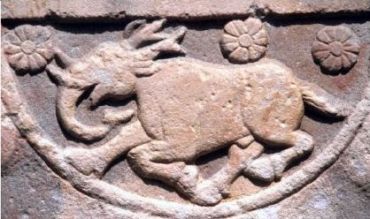
We can only remind the dying Hindu how his brave and manly forefathers saw themselves. This 1st century sculpture from madhya-desha depicts the self-identity of those gallant men, through an intriguing admixture of three most manly creatures they knew from their social life: ashva, gaja and vR^iShabha.  All mixed into an inseparable whole: the Horse, swift, steady and full of vitality; the Elephant, powerful, fearless and invincible; the Bull, full of virility, and of untiring enterprise!

gajAshvavR^iShabha

This is how the Hindu of that age saw himself, and more than then, this is how his progeny has to behave today if they desire to at least put up a meaningful front in the ongoing existential battle for survival in the very homeland of their grandfathers.

January 24, 2009

On the shores of sacred puShkara

by Sarvesh K Tiwari

It was on the day of amAvasyA during the fortnight which one spends in the sacred memory of one’s ancestors, coinciding too with somavAra, making the day even more auspicious, that we had the fortune to be on the shores of the sacred lake of puShkara, that famed tIrtha, where perpetually reside, as purANa-s describe, all the Adityans, all the vasu-s, all the rudra-s and all the mAruta-s!

It was on these very shores, says dwaipAyana, that janArdana had dwelt for many years, engaged in arduous tapa-s, that slayer of madhu the asura!

It was here, where the third of the pANDava heroes had sojourned during the last one of his twelve fugitive years of exile from khANDavaprastha.

It was here where sheSha had performed the feat of penances which had pleased prajApati to free him up from his sinful association with his nAga brethren of ill deeds, and where he acquired for himself the eternal anugraha of viShNu.

Indeed, one acquires not by the performance of the agniShToma and other yaj~nas, that much merit which one aquires by a sojourn to this tirtha, so describe our purANa-s, in particular the padma, garuDa, vArAha, skanda and vAmana.

It was here, so inform us our traditions, where one of the twin droplets of the divine tear befell on earth, from the lashes of that most benevolent deva of deva-s, the Supreme Ascetic, the cause of all the causes and the end to all the ends, that Lord of umA who had cried and danced in His divine anguish. It was that one drop of tear that became the reservoir of puShkara, whereas the other tear caused sacred kaTas, its sibling lake on the borders of sindhudesha and pA~nchanada, now in the terrorist country.

It was here, that the illustrious grandsire of all creation, who has lotus for his seat, had dwelt with great pleasure, and performed his grand yaj~na. And it was here that invited by prajApati, saraswatI had appeared, that foremost of all the rivers in the world, the mother most magnanimous and nourisher of sudhI-s, and she was called here as supravA by the sages, thereby blessing puShkara with first of her seven subsequent incarnations through which she nurtured the creation.

Indeed, as the slayer of madhu is regarded the foremost of all the celestials, so also this puShkara the foremost of all the tIrtha-s. And yet, wonders the great bhArata, why this tIrtha goes by the name of “puShkara”, with its three white hillocks and three springs, famed from the remotest times!

Therefore, as we beheld the marvel of this sacred lake, we wondered howmany generations of our forefathers too would have similarly beheld this lake, and would have offered tarpaNa to their forefathers, like we did to them!

And then, as a sudden pang, this old thirteenth century song surfaced in our memory, translation of which we had once read in the ‘Autobiography of An Unknown Indian’ by Nirad C Choudhury, and which was a sad lamentation of a Hindu poet, whose heart was crying over turuShka defilement around the sacred lake. The song went something like this:

puShkara, once the abode of bramhA,
Now home of the mlechcHa…

bramhA bathed there after concluding his yaj~na
Now mlechcHa removes in its waters the fatigue of demolishing our sacred temples…

Once this lake was the repository of the tears of joy of viShNu
Now a bin for the waste of mlechcHa’s meals…

Once warmed up by the fire of the eyes of The Eleven rudra-s
Now steaming with the hot tears of persecuted brAhmaNa-s…

apsaras were forbidden to enter its waters,
Even indrANI considered it not proper to bathe here,
Now becomes the wallowing pool for turuShkanI women in their menses…

Once deva-s quenched their thirst from it,
Now supplies to these barbarians who dont hesitate to slaughter their horses to quench their thirsts in the desert…

And even as we were taken to the famed shrine of prajApati, and also the place where sagacious dayAnanda of blessed memory, the founder of Arya samAja, had spent his early years in learning the veda-s — we hardly recovered from the torment.

Tags: ,
Design a site like this with WordPress.com
Get started