In the previous parts (1:hitopadesha, 2:pa~nchatantra and chANakya) we have seen how the ancient texts of nIti have treated the aphorism of vasudhaiva kuTumbakaM. In this concluding part, we shall survey the rest of the sources where this shloka has appeared and understand the contexts of its usage.
vasudhaiva kuTumbakam in vikrama-charita
Very few monarchs come close to finding a comparable place in the Hindu subconscious, which even after the elapse of a millennium, the memory of legendary bhojadeva paramAra of dhArAvatI commands. Unlike others confined to the pages of history, his legacy lives on in so many ways, in urban proverbs and rural songs, in crude jokes and scholarly legends, or in massively popular folklores inspired by siMhAsana-battIsI aka dvA-triMshata-puttalikA-siMhAsanam or vikrama-charita, which to this date are the favorite of rural storytellers.
First composed probably during the reign of bhoja in the eleventh century CE, or more likely shortly afterwards, this collection of thirty-two tales eventually became so popular that these were transmitted very early, as early as 1305, to even far away Mongolia and thence to Russia and Germany, so that even today ‘Arji Buji’ (from rAjA bhoja) is a hero in Mongolian folklore, and at least one story of Grimms’ collection of German tales is based on this work too.
The framework of the collection is such, that in its each tale bhoja tries to ascend a throne belonging to the legendary vikramAditya, supported by a base of thirty-two statuettes. In each attempt, one of the statuettes would recite to him a story about the greatness of vikramAditya and demand bhoja whether he was up to him in virtue. Hearing the tale bhoja would silently step back from the throne in humility, until the very end of the work when he would be proclaimed entitled to the throne by the very decree of Gods, a symbolic way of the author to claim for bhoja the same pedestal in glory as that of vikramAditya the chief hero of these tales.
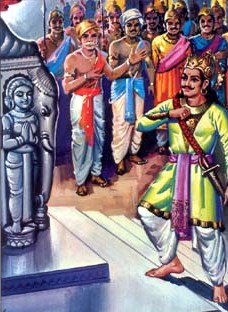
It is in this popular work that we find our next stop for the shloka of vasudhaiva kuTumbakam, and at last here it is seen definitely in a positive sense. There are six major recensions found of vikrama-charita: a most common southern recension, manuscripts of which are found mostly from Andhra; a metrical recension with entire text in anuShtubha meter; a prose-only brief recension; two individual jaina recensions in devanAgarI mostly from central and western India; and finally a recension of vararuchi. Then there is another popular collection of tales spawned by vikrama-charita: twenty-five vetAla fables known as vetAla pa~nchaviMshati or vetAla pachIsI, the germs of which are found in one of the 32-siMhAsana tales itself.
Among all the six recensions, VK can be sited in three, coming in three separate stories.
In the southern recension mostly in Telugu manuscripts, the shloka appears in the opening of a tale called sarvasva-dakShiNA-yaj~na-varNanam recited to bhoja by the third puttalikA named suprabhA. Here the VK shloka is a very different variant from the popular one:
अयं निजः परोवेति विकल्पो भ्रान्तचेतसाम
पुनस्तूदार चित्तानां वसुधैव कुटुम्बकम (वि.च, आन्ध्र, ३.१)
ayaM nijaH paroveti vikalpo bhrAnta chetasAm
punastUdAra chittAnAM vasudhaiva kuTumbakam (VC, Andhra, 3.1)
This tale which opens with VK is about vikramArka’s bravery in renunciation. He once decides to perform a grand ya~jna in ujjayinI, in connection of which he dispatches a brAhmaNa towards south to invite Sea-God. While Sea-God did not come, he returned the brAhmaNa with a gift of four rare magical gems for vikrama, each of which had a different magical quality. By the time this envoy returns back to ujjayinI, the yaj~na is completed and the king has donated everything he had to others. Having nothing left with him, he would ask this brAhmaNa to accept any one of those gems whichever he chose. An interesting debate would ensue between the brAhmaNa, his wife, son and daughter-in-law, about which one of the four gems should be kept. In the end they being undecided, vikrama would generously grant them all the four gems, even though he had no wealth left with himself and was in need.
In the jaina recension, the shloka of VK appears in an intriguing tale known as paropakArAya-svadehAhuti-dAna, recited by suprabhA who is here the seventeenth statuette. This tale too is about the magnanimity of vikrama and his generous disposition. In this story, there is a certain ruler of an insignificant fiefdom who once overhears the praises of vikrama and inquires as to why vikrama was so great. He is told that it was because of his generosity in donations. In jealousy the ruler decides to perform his own enterprise of donations, but having not sufficient income he would think of generating wealth through tantra-prayoga. He contracts a group of sixty-four yoginI-s to perform a certain anuShThAna which every time conducted would produce for him a certain amount of gold. However each time he would have to give up his body in an arduous prayoga at the end of which the yoginI-s would resurrect him with a new body. This painful exercise was undertaken a few times while vikramAditya came to learn about it. So one day when the prayoga was on, at the right moment vikrama would appear at the scene and jump into flames. The yoginI-s would be greatly pleased and after resurrecting him, they would grant him a desired boon. The story climaxes with vikrama’s generosity, when he appeals to yoginI-s to grant wealth to the jealous ruler without having to repeatedly undergo that ordeal.
In yet another jaina recension, and a quite late one written by paNDita shubhashIla gaNi in 1437 CE, the standard shloka of VK recurs in yet another story where it represents the justice of vikrama.
In the other recensions the shloka is simply absent. Incidentally, bhojadeva also composed (or commissioned) a compendium of subhAShita-s attributed to kauTilya, titled chANakya-rAjanIti-shAstra, and VK is not found in the versions we have seen so far.
VK appears this way in vikrama-charita, representing the generosity and justice of the king, and yet, not in any sense of universal brotherhood as is commonly misunderstood these days.
vasudhaiva kuTumbakam in Classical Poetics
Now, if the authors of various recensions of vikrama-charita decided to quote VK to highlight the magnanimity of their hero, it must have surely been a popular shloka by their time representing the sentiment of generosity. Indeed VK has appeared in all of these, explicitly in sense of being quoted from some reference. If so, where could that be from?
We have to understand that by the time of their composition, the art of poetics in saMskR^ita literature had been transformed into a proper discipline of science. Precision in characterization of each emotion, appropriateness of expression, accuracy in usage of right meters for specific purposes, acceptable tolerance of liberty with grammar in poetry, how and when new words can be coined if at all – these had become commonplace knowledge among not only saMskR^ita literati but even broader elites. A few distinct, independent, and competing schools of thought on poetic discipline had already evolved and matured such as the vaidarbha, kAshmIraka and gauDIya schools.
And as far as quoting from a common text is concerned, we should remember that by this time, the system of yellow-pages-like encyclopedic anthologies of subhAShita-s, the free floating, orally transmitted, public domain maxims, adages and aphorisms, had also become quite popular. Such anthologies, often called kosha-s or saMgraha-s were not only useful to common users to enhance their expression in speech, but also certainly referred by the dramatists and prose-writers such as those of vikrama-charita, to quote suitably according to the mood and situation of the context.
subhAShitAvaliH of vallabhadeva is one such grand collection with thousands of such poetic phrases coming from dozens of poets, and classified under various topics. It lists the shloka of vasudhaiva kuTumbakaM as an ideal expression of audArya, the sentiment of generosity, in its following variant:
अयं बन्धुः परोवेति गणना लघु चेतसाम
पुंसामुदार चित्तानां वसुधैव कुटुम्बकम (उदाराः, ४९८)
ayaM bandhuH paroveti gaNanA laghu chetasAM
pumsAmudAra chittAnAM vasudhaiva kuTumbakaM (subhAShitAvaliH, udArAH, 498.)
vallabhadeva has listed VK as third in the sequence under ‘generosity’ (ironically, next to the section on niggardly misers). vallabhadeva hands us another very significant lead by assigning the authorship of this shloka to udbhaTa bhaTTa an eighth-century poet from kAshmIra, who was an important milestone in the progress of kAshmIraka brand of poetics, the development of which began with bhAmaha and completed in mammaTa.
Now let us then examine where exactly and in which context udbhaTa might have uttered this verse. Of all that is available anymore from the pen of udbhaTa, and he is said to have composed at least three major works, we are unable to find the shloka of VK. We do know through his contemporaries that he composed bhAmaha-vivaraNa a commentary on bhAmaha, kumara-sambhava a kAvya, and kAvyAlaMkAra-sAra-saMgraha, a treatise on recommended expressions and embellishments in poetry. Of these the first two are lost and not extant anymore — the first one probably falling to disuse after mammaTa had delivered the last word on the subject, and kumara-sambhava probably drowned in competition to the mahAkAvya of same title by the emperor of saMskR^ita poetry. However, his kAvyAlaMkAra-sAra-saMgraha is still extant besides other snippets of his, quoted by writers such as indurAja the teacher of savant abhinavagupta in his laghuvR^itti, or indeed like the three verses of his preserved by vallabhadeva in subhAShitAvaliH from where we came to him.
Therefore, it is entirely possible that udbhaTa might have used the shloka of VK is some works which are lost to us, although we have no means of knowing the context in which he would have used VK. But we do know that he would have been only quoting this shloka and not have been its original author as claimed by vallabhadeva, since more than a full millennium before udbhaTa, viShNUsharman had already quoted it in pa~nchatantra.
Talking of poetry and talking of vikramAditya and bhoja, another name that naturally springs up in our minds is bhartR^ihari, the maverick elder brother of vikramAditya. bhartR^ihari’s three famous volumes of a hundred shloka-s each, nIti-shatakam, vairAgya-shatakam, and shR^iMgAra-shatakam, are very widespread and commonly found. Although the contents of shataka-s vary between various versions of theirs, the sholka of VK is not found in any of these that we have seen so far except for one edition compiled by Marxist historian D.D. Kosambi. [bhartR^ihari-viracita-shatakatrayAdi-subhAShita-saMgraha, D.D.Kosambi (1948.)]. However, considering the overwhelming evidence of VK being absent in a vast majority of various recensions of bhartR^ihari’s trayI, it seems more sensible to conclude that it must have been an interpolation in this single source where kosambi sighted it. Besides, as the earlier works already quote this shloka, that rules out its authorship to bhartR^ihari.
vasudhaiva kuTumbakam in upaniShada
So far we have seen hitopadesha and pa~nchatantra, compendiums of aphorisms of kauTilya and bhartR^ihari, Andhra and jaina recensions of vikrama-charita, encyclopedic anthology by vallabhadeva and through him the snippets of udbhaTa. Nowhere, not in the least, do the authors of any of these works ever claim to be the origin of vasudhaiva kuTumbakam. In every single instance, the verse has been explicitly quoted as a remark often appended with ‘as has been said’.
But there is one and the only one exception to this where this shloka comes as a natural, inherent and intrinsic part of the base text, and that is why we had kept that source to be examined in the end.
In the seventh adhikaraNa of the second chapter of shrI-bhAShyam, the prominent and most celebrated commentary on bramha-sUtra, AchArya rAmAnuja is critiquing the philosophies of kApAla, kAlamukha and pAshupata schools of shaiva mata-s in its thirty-sixth sUtra. There, he quotes in support of his arguments the first line of a rather less known and referred upaniShada – mahopaniShada (“eko ha vai nArAyaNa AsinnabramhA neshAnaH… sa ekAkI na ramate” MU1.1). Now this upaniShada, although not as much circulated or read as the others, is certainly not devoid of authenticity and importance. For, we also find many other classical vedAntins making references to mahopaniShada, including but not limited to yamunAchArya in puruSha-nirNaya, nArAyaNArya in tattva-nirNaya, and yAdavaprakAsha in his commentary on the bhagavadgItA, to mention but a few.
The shloka of vasudhiava-kuTumbakam, a slightly different variant of it, is to be found in this mahopaniShada as the seventy-second shloka of its sixth chapter. Here instead of ‘ayaM nijaH paroveti’, the shloka reads as ‘ayaM bandhurayaM neti’ (‘this is a friend and that one not’), while the rest of the anuShTubha remains the same.
To understand the total meaning and context of VK here, quoted below are the shloka-s 70-73 from its sixth chapter:
उदारः पेशलाचारः सर्वाचारानुवृत्तिमान
अन्तःसङ्ग-परित्यागी बहिः संभारवानिव
अन्तर्वैराग्यमादाय बहिराशोन्मुखेहितः
अयं बन्धुरयं नेति गणना लघुचेतसां
उदारचरितानां तु वसुधैव कुटुम्बकं
भावाभाव विनिर्मुक्तं जरामरणवर्जितं
प्रशान्त कलनारभ्यं नीरागं पदमाश्रय
एषा ब्राम्ही स्थितिः स्वच्छा निष्कामा विगतामया
आदाय विहरन्नेवं संकटेषु न मुह्यति
(महोपनिषद ६.७०-७३)
The above text is describing the lakShaNa and behaviour of great men who are elevated to the coveted brAmhI sthiti of spiritual realm. The above says:
“(That elevated one in brAmhI sthiti) is generous, always clean in behaviour, in accordance to the established norms of conduct, and free from all attachments in life. From inside, he has renounced everything, even though outwardly he would appear to carry out worldly duties (like any other mortal. However, unlike) the small hearts of (ordinary) people (who discriminate by) saying ‘This one is a friend and that one a stranger’ these (great men in brAmhI-sthiti) are of magnanimous hearts and embrace the entire world as their own family. They have gained liberation from all constraints of ordinary life, like old age and death; their fires (of klesha-s) have become extinguished; and in them no attachment finds any shelter (anymore). Such (Listen O best amongst the brAhmaNa-s, are those who have achieved) the status of brAmhI sthiti, the absolutely pure; that which is beyond all cravings and sufferings. Equipped with such attributes they freely roam (the earth), without knowing any calamity.”
Not a recommendation or prescription of any sort, not an ideal or a goal for soceity to acheive, having nothing to do with anything outside the realm of individual spirituality, and simply a statement on the very nature of the bramhavetta-s of highest attainment.
Closing Remarks
We had set out on an excursion into the forest of saMskR^ita literature, to figure out where does the famed verse of vasudhaiva kuTumbakam come from, what was the sense and context in which the ancient AchArya-s had uttered it, and whether they ever meant this shloka to mean a recommendation for unconditional universal brotherhood or a principle of state. We also wanted to figure out the origin as well as transmission of the shloka through the periods of Hindu history.
1. mahopaniShada (6.72) uses the shloka to describe one of the lakShaNa-s of brAmhI-sthiti of highest level of spiritual progress. As we noted earlier, mahopaniShada is the only text where the shloka of vasudhaiva kuTumbakam is the natural and intrinsic part of the rest of the text, whereas in others the shloka has been quoted as an explicit quotation. We have therefore a very strong reason to comfortably believe that this upaniShada might be the original source of this shloka. Indeed, by the very nature, upaniShadakAra-s, tend to be original except for quoting the passages of or retelling the themes from veda-s or at times from other upaniShada-s, but never from any external literature, whereas the reverse can be seen very often. Besides, an upaniShada quoting an already popular shloaka and in a natural sense of its integral text is unimaginable. Indeed the upaniShada having VK and so many early texts as the pa~nchatantra quoting it, itself would support an early date for this part of the mahopaniShada if not whole.
Besides, so many of vedAntin commentators especially of vaiShNava bent, quoting it in their works supports its popularity: in shrI-bhAShyam (2.7.36) by rAmAnujAcharya (~1080 CE), in puruSha-nirNaya by yamunAchArya, in tattva-nirNaya by nArAyaNArya, in a commentary on the bhagavadgItA by yAdava prakAsha, and a complete commentary on mahopaniShada by sha~nkarAnanda (~1300 CE).
The AchArya of mAnasataraMgiNI suggests that the parts of mahopaniShada might actually have predated mahAbhArata, as supported by not one but two references to the mahopaniShada in the nArAyaNIya section of the shAnti parvan as follows:
महोपनिषदं मन्त्रम अधीयानान स्वरान्वितम
पञ्चोपनिषदैर मन्त्रैर मनसा ध्यायतः शुची || १२.३२५.२
and:
इदं महोपनिषदं चतुर्वेद-समन्वितम
सांख्ययोगकृतं तेन पञ्चरात्रानुशब्दितम || १२.३२६.१००
(नारायणीय, शान्तिपर्व, महाभारत)
It does seem likely that the pre-mantramArga pA~ncharAtra vaiShNava-s had a mahopaniShada that was the core of the text that today survives under that name, and VK might be present in that ur-text of mahopaniShada. This would also mean that a such a mahopaniShada was in place before it became widely popular and viShNusharman quoted it.
2. pa~nchatantra (5.3.37) has it come from a declared fool who is killed by his naivety, suggesting it as a symbol of impracticality. This text was certainly written towards the end of the mauryan empire. In political sphere, smaller janapada-s were witnessing a revival along side foreign invasions. In social sphere, jaina, bauddha and vaiShNava mata-s were witnessing popularity. It must have been under such politico-social conditions, and in response to the pacifist tendencies, that viShNusharman must have warned against the tendency represented by vasudhaiva kuTumbakam, by making it an utterance of a fool who dies from his naivety itself.
3. hitopadesha (1.3.71) goes a step further along the same lines as pa~nchatantra, and clearly demonstrated through two satires, its usage by subversionists as well as tendency of gullible to fall for it. It also praises the realist heroes that are not influenced by VK-speech.
Immediately preceding to its composition, one should also notice the southern version of pa~nchatantra-s mentioning a similar message in their tales, an iconographic representation of which was even sculpted on the bas-relief of the mahAbalIpuram temple by the pallava-s, an image of which is presented in the end of this article.
4. kauTilyan compendiums don’t have VK, except for two minor recensions, and kauTilyan thought is incompatible with what is generally understood as the sentiment of VK.
5. 8th century udbhaTa bhaTTa might have quoted it in some poetical work that is no more extant, and therefore we don’t know its context.
6. subhAShitAvaliH (udArAH.498.) lists this as a subhAShita for its poetic value in representing kindness. Also important to note is that by this time, people had already forgotten the source of the shloka, as vallabhadeva mistakenly attributes its origin to eighth century kashMiraka poet udbhaTa, not knowing that it was present even in such popular texts as the pa~nchatantra.
7. The three recensions of vikrama-charita (Andhra 3.1, Jaina 17.3, Jaina-shubhashIla 6.270) quote VK to stand for generosity and justice, but still not any universal brotherhood.
Now we can safely conclude by saying that this shloka, snatched away from the original contexts as mahopaniShada presented it in, and disregarding how hitopadesha and pa~nchatantra and vikramacharita have used it, when it is sited by politicians and policy-makers as an ancient authority of liberalism and internationalism, the shloka is no more than a hoax. When our scholars site this shloka as an evidence of some sort of an ancient Hindu vision of utopic universal brotherhood, the shloka is again no more than a hoax. And when we hear our religious preachers sermonise using the shloka for people to follow the ‘principles’ of vasudhaiva kuTumbakam, the shloka is no more than a hoax in that context too.
(Concluded.)


 भारतेन्दु
The Hoax Called Vasudhaiva Kutumbakam – 3: Vikrama, Poetics and Upanishada
by Sarvesh K TiwariIn the previous parts (1:hitopadesha, 2:pa~nchatantra and chANakya) we have seen how the ancient texts of nIti have treated the aphorism of vasudhaiva kuTumbakaM. In this concluding part, we shall survey the rest of the sources where this shloka has appeared and understand the contexts of its usage.
vasudhaiva kuTumbakam in vikrama-charita
Very few monarchs come close to finding a comparable place in the Hindu subconscious, which even after the elapse of a millennium, the memory of legendary bhojadeva paramAra of dhArAvatI commands. Unlike others confined to the pages of history, his legacy lives on in so many ways, in urban proverbs and rural songs, in crude jokes and scholarly legends, or in massively popular folklores inspired by siMhAsana-battIsI aka dvA-triMshata-puttalikA-siMhAsanam or vikrama-charita, which to this date are the favorite of rural storytellers.
First composed probably during the reign of bhoja in the eleventh century CE, or more likely shortly afterwards, this collection of thirty-two tales eventually became so popular that these were transmitted very early, as early as 1305, to even far away Mongolia and thence to Russia and Germany, so that even today ‘Arji Buji’ (from rAjA bhoja) is a hero in Mongolian folklore, and at least one story of Grimms’ collection of German tales is based on this work too.
The framework of the collection is such, that in its each tale bhoja tries to ascend a throne belonging to the legendary vikramAditya, supported by a base of thirty-two statuettes. In each attempt, one of the statuettes would recite to him a story about the greatness of vikramAditya and demand bhoja whether he was up to him in virtue. Hearing the tale bhoja would silently step back from the throne in humility, until the very end of the work when he would be proclaimed entitled to the throne by the very decree of Gods, a symbolic way of the author to claim for bhoja the same pedestal in glory as that of vikramAditya the chief hero of these tales.
It is in this popular work that we find our next stop for the shloka of vasudhaiva kuTumbakam, and at last here it is seen definitely in a positive sense. There are six major recensions found of vikrama-charita: a most common southern recension, manuscripts of which are found mostly from Andhra; a metrical recension with entire text in anuShtubha meter; a prose-only brief recension; two individual jaina recensions in devanAgarI mostly from central and western India; and finally a recension of vararuchi. Then there is another popular collection of tales spawned by vikrama-charita: twenty-five vetAla fables known as vetAla pa~nchaviMshati or vetAla pachIsI, the germs of which are found in one of the 32-siMhAsana tales itself.
Among all the six recensions, VK can be sited in three, coming in three separate stories.
In the southern recension mostly in Telugu manuscripts, the shloka appears in the opening of a tale called sarvasva-dakShiNA-yaj~na-varNanam recited to bhoja by the third puttalikA named suprabhA. Here the VK shloka is a very different variant from the popular one:
This tale which opens with VK is about vikramArka’s bravery in renunciation. He once decides to perform a grand ya~jna in ujjayinI, in connection of which he dispatches a brAhmaNa towards south to invite Sea-God. While Sea-God did not come, he returned the brAhmaNa with a gift of four rare magical gems for vikrama, each of which had a different magical quality. By the time this envoy returns back to ujjayinI, the yaj~na is completed and the king has donated everything he had to others. Having nothing left with him, he would ask this brAhmaNa to accept any one of those gems whichever he chose. An interesting debate would ensue between the brAhmaNa, his wife, son and daughter-in-law, about which one of the four gems should be kept. In the end they being undecided, vikrama would generously grant them all the four gems, even though he had no wealth left with himself and was in need.
In the jaina recension, the shloka of VK appears in an intriguing tale known as paropakArAya-svadehAhuti-dAna, recited by suprabhA who is here the seventeenth statuette. This tale too is about the magnanimity of vikrama and his generous disposition. In this story, there is a certain ruler of an insignificant fiefdom who once overhears the praises of vikrama and inquires as to why vikrama was so great. He is told that it was because of his generosity in donations. In jealousy the ruler decides to perform his own enterprise of donations, but having not sufficient income he would think of generating wealth through tantra-prayoga. He contracts a group of sixty-four yoginI-s to perform a certain anuShThAna which every time conducted would produce for him a certain amount of gold. However each time he would have to give up his body in an arduous prayoga at the end of which the yoginI-s would resurrect him with a new body. This painful exercise was undertaken a few times while vikramAditya came to learn about it. So one day when the prayoga was on, at the right moment vikrama would appear at the scene and jump into flames. The yoginI-s would be greatly pleased and after resurrecting him, they would grant him a desired boon. The story climaxes with vikrama’s generosity, when he appeals to yoginI-s to grant wealth to the jealous ruler without having to repeatedly undergo that ordeal.
In yet another jaina recension, and a quite late one written by paNDita shubhashIla gaNi in 1437 CE, the standard shloka of VK recurs in yet another story where it represents the justice of vikrama.
In the other recensions the shloka is simply absent. Incidentally, bhojadeva also composed (or commissioned) a compendium of subhAShita-s attributed to kauTilya, titled chANakya-rAjanIti-shAstra, and VK is not found in the versions we have seen so far.
VK appears this way in vikrama-charita, representing the generosity and justice of the king, and yet, not in any sense of universal brotherhood as is commonly misunderstood these days.
vasudhaiva kuTumbakam in Classical Poetics
Now, if the authors of various recensions of vikrama-charita decided to quote VK to highlight the magnanimity of their hero, it must have surely been a popular shloka by their time representing the sentiment of generosity. Indeed VK has appeared in all of these, explicitly in sense of being quoted from some reference. If so, where could that be from?
We have to understand that by the time of their composition, the art of poetics in saMskR^ita literature had been transformed into a proper discipline of science. Precision in characterization of each emotion, appropriateness of expression, accuracy in usage of right meters for specific purposes, acceptable tolerance of liberty with grammar in poetry, how and when new words can be coined if at all – these had become commonplace knowledge among not only saMskR^ita literati but even broader elites. A few distinct, independent, and competing schools of thought on poetic discipline had already evolved and matured such as the vaidarbha, kAshmIraka and gauDIya schools.
And as far as quoting from a common text is concerned, we should remember that by this time, the system of yellow-pages-like encyclopedic anthologies of subhAShita-s, the free floating, orally transmitted, public domain maxims, adages and aphorisms, had also become quite popular. Such anthologies, often called kosha-s or saMgraha-s were not only useful to common users to enhance their expression in speech, but also certainly referred by the dramatists and prose-writers such as those of vikrama-charita, to quote suitably according to the mood and situation of the context.
subhAShitAvaliH of vallabhadeva is one such grand collection with thousands of such poetic phrases coming from dozens of poets, and classified under various topics. It lists the shloka of vasudhaiva kuTumbakaM as an ideal expression of audArya, the sentiment of generosity, in its following variant:
vallabhadeva has listed VK as third in the sequence under ‘generosity’ (ironically, next to the section on niggardly misers). vallabhadeva hands us another very significant lead by assigning the authorship of this shloka to udbhaTa bhaTTa an eighth-century poet from kAshmIra, who was an important milestone in the progress of kAshmIraka brand of poetics, the development of which began with bhAmaha and completed in mammaTa.
Now let us then examine where exactly and in which context udbhaTa might have uttered this verse. Of all that is available anymore from the pen of udbhaTa, and he is said to have composed at least three major works, we are unable to find the shloka of VK. We do know through his contemporaries that he composed bhAmaha-vivaraNa a commentary on bhAmaha, kumara-sambhava a kAvya, and kAvyAlaMkAra-sAra-saMgraha, a treatise on recommended expressions and embellishments in poetry. Of these the first two are lost and not extant anymore — the first one probably falling to disuse after mammaTa had delivered the last word on the subject, and kumara-sambhava probably drowned in competition to the mahAkAvya of same title by the emperor of saMskR^ita poetry. However, his kAvyAlaMkAra-sAra-saMgraha is still extant besides other snippets of his, quoted by writers such as indurAja the teacher of savant abhinavagupta in his laghuvR^itti, or indeed like the three verses of his preserved by vallabhadeva in subhAShitAvaliH from where we came to him.
Therefore, it is entirely possible that udbhaTa might have used the shloka of VK is some works which are lost to us, although we have no means of knowing the context in which he would have used VK. But we do know that he would have been only quoting this shloka and not have been its original author as claimed by vallabhadeva, since more than a full millennium before udbhaTa, viShNUsharman had already quoted it in pa~nchatantra.
Talking of poetry and talking of vikramAditya and bhoja, another name that naturally springs up in our minds is bhartR^ihari, the maverick elder brother of vikramAditya. bhartR^ihari’s three famous volumes of a hundred shloka-s each, nIti-shatakam, vairAgya-shatakam, and shR^iMgAra-shatakam, are very widespread and commonly found. Although the contents of shataka-s vary between various versions of theirs, the sholka of VK is not found in any of these that we have seen so far except for one edition compiled by Marxist historian D.D. Kosambi. [bhartR^ihari-viracita-shatakatrayAdi-subhAShita-saMgraha, D.D.Kosambi (1948.)]. However, considering the overwhelming evidence of VK being absent in a vast majority of various recensions of bhartR^ihari’s trayI, it seems more sensible to conclude that it must have been an interpolation in this single source where kosambi sighted it. Besides, as the earlier works already quote this shloka, that rules out its authorship to bhartR^ihari.
vasudhaiva kuTumbakam in upaniShada
So far we have seen hitopadesha and pa~nchatantra, compendiums of aphorisms of kauTilya and bhartR^ihari, Andhra and jaina recensions of vikrama-charita, encyclopedic anthology by vallabhadeva and through him the snippets of udbhaTa. Nowhere, not in the least, do the authors of any of these works ever claim to be the origin of vasudhaiva kuTumbakam. In every single instance, the verse has been explicitly quoted as a remark often appended with ‘as has been said’.
But there is one and the only one exception to this where this shloka comes as a natural, inherent and intrinsic part of the base text, and that is why we had kept that source to be examined in the end.
In the seventh adhikaraNa of the second chapter of shrI-bhAShyam, the prominent and most celebrated commentary on bramha-sUtra, AchArya rAmAnuja is critiquing the philosophies of kApAla, kAlamukha and pAshupata schools of shaiva mata-s in its thirty-sixth sUtra. There, he quotes in support of his arguments the first line of a rather less known and referred upaniShada – mahopaniShada (“eko ha vai nArAyaNa AsinnabramhA neshAnaH… sa ekAkI na ramate” MU1.1). Now this upaniShada, although not as much circulated or read as the others, is certainly not devoid of authenticity and importance. For, we also find many other classical vedAntins making references to mahopaniShada, including but not limited to yamunAchArya in puruSha-nirNaya, nArAyaNArya in tattva-nirNaya, and yAdavaprakAsha in his commentary on the bhagavadgItA, to mention but a few.
The shloka of vasudhiava-kuTumbakam, a slightly different variant of it, is to be found in this mahopaniShada as the seventy-second shloka of its sixth chapter. Here instead of ‘ayaM nijaH paroveti’, the shloka reads as ‘ayaM bandhurayaM neti’ (‘this is a friend and that one not’), while the rest of the anuShTubha remains the same.
To understand the total meaning and context of VK here, quoted below are the shloka-s 70-73 from its sixth chapter:
The above text is describing the lakShaNa and behaviour of great men who are elevated to the coveted brAmhI sthiti of spiritual realm. The above says:
Not a recommendation or prescription of any sort, not an ideal or a goal for soceity to acheive, having nothing to do with anything outside the realm of individual spirituality, and simply a statement on the very nature of the bramhavetta-s of highest attainment.
Closing Remarks
We had set out on an excursion into the forest of saMskR^ita literature, to figure out where does the famed verse of vasudhaiva kuTumbakam come from, what was the sense and context in which the ancient AchArya-s had uttered it, and whether they ever meant this shloka to mean a recommendation for unconditional universal brotherhood or a principle of state. We also wanted to figure out the origin as well as transmission of the shloka through the periods of Hindu history.
1. mahopaniShada (6.72) uses the shloka to describe one of the lakShaNa-s of brAmhI-sthiti of highest level of spiritual progress. As we noted earlier, mahopaniShada is the only text where the shloka of vasudhaiva kuTumbakam is the natural and intrinsic part of the rest of the text, whereas in others the shloka has been quoted as an explicit quotation. We have therefore a very strong reason to comfortably believe that this upaniShada might be the original source of this shloka. Indeed, by the very nature, upaniShadakAra-s, tend to be original except for quoting the passages of or retelling the themes from veda-s or at times from other upaniShada-s, but never from any external literature, whereas the reverse can be seen very often. Besides, an upaniShada quoting an already popular shloaka and in a natural sense of its integral text is unimaginable. Indeed the upaniShada having VK and so many early texts as the pa~nchatantra quoting it, itself would support an early date for this part of the mahopaniShada if not whole.
Besides, so many of vedAntin commentators especially of vaiShNava bent, quoting it in their works supports its popularity: in shrI-bhAShyam (2.7.36) by rAmAnujAcharya (~1080 CE), in puruSha-nirNaya by yamunAchArya, in tattva-nirNaya by nArAyaNArya, in a commentary on the bhagavadgItA by yAdava prakAsha, and a complete commentary on mahopaniShada by sha~nkarAnanda (~1300 CE).
The AchArya of mAnasataraMgiNI suggests that the parts of mahopaniShada might actually have predated mahAbhArata, as supported by not one but two references to the mahopaniShada in the nArAyaNIya section of the shAnti parvan as follows:
It does seem likely that the pre-mantramArga pA~ncharAtra vaiShNava-s had a mahopaniShada that was the core of the text that today survives under that name, and VK might be present in that ur-text of mahopaniShada. This would also mean that a such a mahopaniShada was in place before it became widely popular and viShNusharman quoted it.
2. pa~nchatantra (5.3.37) has it come from a declared fool who is killed by his naivety, suggesting it as a symbol of impracticality. This text was certainly written towards the end of the mauryan empire. In political sphere, smaller janapada-s were witnessing a revival along side foreign invasions. In social sphere, jaina, bauddha and vaiShNava mata-s were witnessing popularity. It must have been under such politico-social conditions, and in response to the pacifist tendencies, that viShNusharman must have warned against the tendency represented by vasudhaiva kuTumbakam, by making it an utterance of a fool who dies from his naivety itself.
3. hitopadesha (1.3.71) goes a step further along the same lines as pa~nchatantra, and clearly demonstrated through two satires, its usage by subversionists as well as tendency of gullible to fall for it. It also praises the realist heroes that are not influenced by VK-speech.
Immediately preceding to its composition, one should also notice the southern version of pa~nchatantra-s mentioning a similar message in their tales, an iconographic representation of which was even sculpted on the bas-relief of the mahAbalIpuram temple by the pallava-s, an image of which is presented in the end of this article.
4. kauTilyan compendiums don’t have VK, except for two minor recensions, and kauTilyan thought is incompatible with what is generally understood as the sentiment of VK.
5. 8th century udbhaTa bhaTTa might have quoted it in some poetical work that is no more extant, and therefore we don’t know its context.
6. subhAShitAvaliH (udArAH.498.) lists this as a subhAShita for its poetic value in representing kindness. Also important to note is that by this time, people had already forgotten the source of the shloka, as vallabhadeva mistakenly attributes its origin to eighth century kashMiraka poet udbhaTa, not knowing that it was present even in such popular texts as the pa~nchatantra.
7. The three recensions of vikrama-charita (Andhra 3.1, Jaina 17.3, Jaina-shubhashIla 6.270) quote VK to stand for generosity and justice, but still not any universal brotherhood.
Now we can safely conclude by saying that this shloka, snatched away from the original contexts as mahopaniShada presented it in, and disregarding how hitopadesha and pa~nchatantra and vikramacharita have used it, when it is sited by politicians and policy-makers as an ancient authority of liberalism and internationalism, the shloka is no more than a hoax. When our scholars site this shloka as an evidence of some sort of an ancient Hindu vision of utopic universal brotherhood, the shloka is again no more than a hoax. And when we hear our religious preachers sermonise using the shloka for people to follow the ‘principles’ of vasudhaiva kuTumbakam, the shloka is no more than a hoax in that context too.
(Concluded.)
Share:
Posted in Commentary, History, Literature, Scripture, Tradition | 27 Comments »