Author Archive

February 14, 2009

vasanta and kAmadeva in shivapurANa

by Sarvesh K Tiwari

We glean through that portion of the shiva purANa where makaradhwaja boasts of his glory to devarAja, and mentions the season of vasanta as his retainer:

pa~nchaiva mR^idavo vANaste cha puShpamayA mama
chApastridhA puShpamayaH shijinIbhramarArjjitA
balaM sudayitA me vai vasantaH sachivaH smR^itaH
ahaM pa~Nchabalo devA mitraM mama sudhAnidhiH
senApatishcha shR^i~NgAro hAvabhAvashcha sainikAH
sarve me mR^idavaH shakra ahaM chApi tathAvidhaH
(shivapurANa, rudrasaMhitA, pArvatIkhaNDa)

{Made of tender flowers are the five arrows of mine,
which shoot from a flowery bow through three points, pratya~nchA of which emits the buzzing sound of bees
One’s beloved is my force, season of vasanta my attendant and secretary,
It is I who command the five senses, and I have the moon for my friend,
flirtatious gestures I appoint my soldiers; and shR^i~NgAra their lieutenant}

SP on the utpatti of vasanta season:

chintAviShTasya me tasya niHshvAso yo viniHsR^itaH
tasmAt vasantaH saMjAtaH puShpavrAtavibhUShitaH (2.2.8.37)

{(says prajApati,) Being engrossed so in my botheration, the sigh which I emitted,
gave birth to vasanta decorated with its flock of flowers}

In an archaic way SP etymologically connects vasanta with vasati:

vasanterantahetutvAd vasantAkyo abhavatayam (2.2.8.47)

{it is vasanta that ultimately causes vasati, or home (by inducing the motivation for settling down in marriage!)}

It seems there must have been temples dedicated to madanadeva in ancient Hindu soceity, and during the days preceding to the holikotsava, Hindus did celebrate madanotsava dedicated to kAmadeva. Now a days of course, it has become limited only to the celebration of colourful holI.

In mR^ichcHakaTike we find multiple mentions of madanAyatana, i.e. the temple to kAmadeva. and aside from a shrine in devapATana in nepAla, where He appears fused into imagery of mahAdeva, we are not aware of any functioning temple to kAmadeva.

Tags:
January 29, 2009

When kR^iShNa was gifted Chinese stuff!

by Sarvesh K Tiwari

Interestingly, mahAbhArata mentions clothes ‘made-in-china’ as worthy of royal gifts!

Here we find dhR^itarAShTra ordering vidura, his half-brother and Prime Minister, about preparations to be made for keshava’s imminent visit to hastinApura. He mentions the presents he would like to be prepared for the offering to kR^iShNa when he arrives. The list concludes as follows:

ajinAnAn sahasrANi chIna deshodbhavAni cha
tAnyapyasmai pradAsyAmi yAvadarhati keshavaH
(udyoga-parvan)

“I shall also present keshava deer-skins produced in the country of chIna, a thousand in number, and also other things worthy of him”

This chinese mention comes at the end of a longish list of other such novelties, therefore probably meant as the best of all.

At another place, in sabhA-parvan the second book of bhArata, we find his eldest son duryodhana describing the gifts that yudhiShThira had received from various royalties around the world, during the rAjasUya feat of the pANdava-s. Describing the presents brought by the vAhlIka-s i.e. natives of balkha region, he mentions among other things:

pramANa rAgasparshADhyaM bAhlI chIna samudbhavam
aurNa.n cha rA~NkavaM chaiva kITajaM paTTajaM tathA
kuTTI kR^ita.n tathaivAnyatkamalAbha.n sahasrashaH
sulakShNa.n vastramakArpAsamAvikaM mR^idu chAjinam
(sabhA-parvan)

“And the vAhlIka-s also presented numerous types of exotic fabrics produced in chIna country: the woollens of finest texture; the fabric manufactured from metal wires (or deer skins); those of jute and others material; the fabric spun from fine silken threads produced by worms; they also gifted thousands of different fabrics, cotton and others, of brilliant colours like the bright lotus flowers, besides thousands of deer-skins, all of the velvety texture!”

Interesting, though not surprising. As we do know, until very recent times, Indians used to consider the skins of Deer (and also Tiger) as auspicious to be used as the bedsheets and cover sheets for religious occasions. Yogins and others even today use these texture as their seat-material and the cloth. Besides the himAlayan regions of India, the regions from chIna to Korea to Siberia is known to even today be a very rich habitation of diverse Deer species. Between China and India, almost all the species of Deer in the world can be found.

Similar is the case of silken and woolen fabrics. chIna is known to be a very old commercial source of the both. (silk route)

Not that the regions of bhArata did not produce these materials indigenously– the value of the gifts is in these being of foreign origin therefore exotic, and worthy of royal gifts. In both the cases, the import of these chinese goods into India is mentioned as done by foreigners. In the first case, dhR^itarAShTra mentions having received these as gifts himself from a certain hill-tribes, and in the second the gift is coming from Balkhans.

We must also add another caveat. “chIna” of the itihAsa-purANa-s is not the China of today. Most commonly chIna is used to refer to the North-west region neighboring the Balkh, around the modern turkmenistan and east, and border areas of modern chIna especially Tibet.

Tags:
January 24, 2009

On the shores of sacred puShkara

by Sarvesh K Tiwari

It was on the day of amAvasyA during the fortnight which one spends in the sacred memory of one’s ancestors, coinciding too with somavAra, making the day even more auspicious, that we had the fortune to be on the shores of the sacred lake of puShkara, that famed tIrtha, where perpetually reside, as purANa-s describe, all the Adityans, all the vasu-s, all the rudra-s and all the mAruta-s!

It was on these very shores, says dwaipAyana, that janArdana had dwelt for many years, engaged in arduous tapa-s, that slayer of madhu the asura!

It was here, where the third of the pANDava heroes had sojourned during the last one of his twelve fugitive years of exile from khANDavaprastha.

It was here where sheSha had performed the feat of penances which had pleased prajApati to free him up from his sinful association with his nAga brethren of ill deeds, and where he acquired for himself the eternal anugraha of viShNu.

Indeed, one acquires not by the performance of the agniShToma and other yaj~nas, that much merit which one aquires by a sojourn to this tirtha, so describe our purANa-s, in particular the padma, garuDa, vArAha, skanda and vAmana.

It was here, so inform us our traditions, where one of the twin droplets of the divine tear befell on earth, from the lashes of that most benevolent deva of deva-s, the Supreme Ascetic, the cause of all the causes and the end to all the ends, that Lord of umA who had cried and danced in His divine anguish. It was that one drop of tear that became the reservoir of puShkara, whereas the other tear caused sacred kaTas, its sibling lake on the borders of sindhudesha and pA~nchanada, now in the terrorist country.

It was here, that the illustrious grandsire of all creation, who has lotus for his seat, had dwelt with great pleasure, and performed his grand yaj~na. And it was here that invited by prajApati, saraswatI had appeared, that foremost of all the rivers in the world, the mother most magnanimous and nourisher of sudhI-s, and she was called here as supravA by the sages, thereby blessing puShkara with first of her seven subsequent incarnations through which she nurtured the creation.

Indeed, as the slayer of madhu is regarded the foremost of all the celestials, so also this puShkara the foremost of all the tIrtha-s. And yet, wonders the great bhArata, why this tIrtha goes by the name of “puShkara”, with its three white hillocks and three springs, famed from the remotest times!

Therefore, as we beheld the marvel of this sacred lake, we wondered howmany generations of our forefathers too would have similarly beheld this lake, and would have offered tarpaNa to their forefathers, like we did to them!

And then, as a sudden pang, this old thirteenth century song surfaced in our memory, translation of which we had once read in the ‘Autobiography of An Unknown Indian’ by Nirad C Choudhury, and which was a sad lamentation of a Hindu poet, whose heart was crying over turuShka defilement around the sacred lake. The song went something like this:

puShkara, once the abode of bramhA,
Now home of the mlechcHa…

bramhA bathed there after concluding his yaj~na
Now mlechcHa removes in its waters the fatigue of demolishing our sacred temples…

Once this lake was the repository of the tears of joy of viShNu
Now a bin for the waste of mlechcHa’s meals…

Once warmed up by the fire of the eyes of The Eleven rudra-s
Now steaming with the hot tears of persecuted brAhmaNa-s…

apsaras were forbidden to enter its waters,
Even indrANI considered it not proper to bathe here,
Now becomes the wallowing pool for turuShkanI women in their menses…

Once deva-s quenched their thirst from it,
Now supplies to these barbarians who dont hesitate to slaughter their horses to quench their thirsts in the desert…

And even as we were taken to the famed shrine of prajApati, and also the place where sagacious dayAnanda of blessed memory, the founder of Arya samAja, had spent his early years in learning the veda-s — we hardly recovered from the torment.
Tags: ,
December 31, 2008

sarajA shivAjI rAma hI ko avatAru hai [shivarAja-bhUShaNa 166]

by Sarvesh K Tiwari

…and rAma setu also finds mention in the annals from the pen of the favourite poet of cHatrapati shivAjI.

In this clever kavitta, with a marvelous turn of phrases, our king of poets bhUShaNa churns out a dual-meaning (shleSha) poem.  On one hand, he offers a description of rAmachandra, and on the other that of shivAjI’s, and in the last line equates the two.  Here is the kavitta in manaharaNa meter variety:

सी-ता संग सोभित सुलच्छ्न सहाय जाके
…भू पर भरत नाम भाई नीति चारु है
भूषन भनत कुल-सूर कुल-भूषन हैं
…दासरथी सब दास जाके भुज भुव भारु है
अरि-लँक तोर जोर जाके संग बन्दर हैं
…सिन्धु रहैं बान्धे जाके दल को न पारु है
तेगहि कै भेंटै जौन राकस मरद जानै
…सरजा सिवाजी राम ही को अवतारु हैं !!

The two different meanings are in the subsequent lines in different colours:

Whose presence is ever embellished by Sita by His side and graced by lakShamaNa to His assistance
Whose side shrI never leaves, and who is always assisted by the generals of good lakShaNa
Whose brother named bharata is always eager to spreads benevolence on earth in his name
Whose name this earth takes with affection as a “bhartA”, the nourisher
Says bhUShaNa, He Who is the real crown-jewel of all sUrya-kula
Says bhUShaNa, He Who is the real crown-jewel of all shUra-s (braves)
That son of dasharatha, whose arms are supporting the weight of entire earth
In whose service are valorous rathI-s (Lieutenants) to support the weight of the kingdom
To fame of whose might is destruction of laMkA in collaboraton with vAnara-s
Who breaks the very back of the enemy, such are whose mighty arrows
Who even constructed a bridge over ocean, whose army has no count
At doors of whose forts are always dwelling elephants, whose army has no count
Who knows how to slay rAkShasa-s when encountered
The Very embodiment of manliness who meets his enemies only with his sword
That shivAjI, the Lionheart, says bhUShaNa, is none other than another incarnation of rAmachandra!

Do notice the turn of words… “sindhu rahain bAndhe” means ‘constructed setubandha’ and since sindura also means elephant, the phrase becomes “sindhura hain bAndhe”, ‘Elephants are tied’ too!  Likewise, “marada” while means ‘slaying’ in one sense, but also ‘Manliness’ in the second…

It is not without a reason that bhUShaNa has always left us mesmerized!

December 30, 2008

cHUTyo hai hulAsa… [shivarAja bhUShaNa 150]

by Sarvesh K Tiwari

Words of fire from kavirAja bhUShaNa have always held us captivated since the days of boyhood.  Whenever we heard from our teachers and elders, his terse cHappaya or kavitta in unadulterated braja, we were quickly transported to some other world with our heartbeats accelerated and those hormones further soaring that run high during youth.  Our childhood memories associate bhUShaNa with one of our AchArya-s in school who used to teach us hindI and saMskR^ita, and who transmitted this contagious bhUShaNa-fascination to many of us.

This magnum-opus, shivarAja-bhUShaNa, the fiery poetic annals of the life of the cHatrapati founder of the hindavI swarAja written by bhUShaNa, his contemporary, appears to have quickly lost out these days in popularity, probably since his kliShTa braja is hard to understand even for an average speaker of Hindi, what to say of non-Hindi speakers, in this age when all our languages, indeed the whole cultural continuum, seems to be suffering a major, lasting, and deliberate disruption. While we can do little about that, what we shall do for our own pleasure is to reproduce and translate in English, some of these words, although we are not upto the task to preserve even to a small fraction, the original fire that the lines of bhUShaNa radiate.

So, here goes the first episode (in no particular order of SB):

छूट्यो है हुलास आमखास एक संग छूट्यो
…हरम सरम एक संग बिनु ढंग ही
नैनन तें नीरधीर छूट्यो एक संग छूट्यो
…सुखरुचि मुखरुचि त्यों ही मनरंग ही
भूषण बखानै सिवराज मरदाने तेरी –
…धाक बिललाने न गहत बल अंग ही
दक्खिन के सूबा पाय दिली के अमीर तजें
…उत्तर की आस जीव आस एक संग ही ॥
(SB.150, ‘sahokti’ alaMkAra in kavitta meter of the ‘manaharaNa’ vareity)

With all excitement evaporated; matters of palace and forts interest no more;
Harem and chivalry have suddenly lost meaning;
Pride has left the glances so also bravery the heart;
Tastes and Pleasures, ‘ve all dried up; face paled…
O shivarAja, how should bhUShaNa speak of your manliness!
Effect of your terror is such, that
No boastfulness (of their bravery, by their bards) brings life back to the Amirs of Delhi,
When ordered to march to the Southern Provinces,
Indeed cease both at once: hopes of ever returning back to the North, and desire of life!

The poem describes the terror of the founder of marahaTTA nation in the hearts of the Imperial officers of Delhi, when they hear about their posting in the South.

December 27, 2008

Because Thou lovest the shmashAna…

by Sarvesh K Tiwari

Because Thou lovest the shmashAna,

I have made a shmashAna of my heart

That Thou, Dark One, haunter of the shmashAna,

Mayest dance Thy eternal dance…

Nought else is within my heart, O Mother

Day and night blazes the funeral pyre

The ashes of the dead, strewn all about

I have preserved against Thy coming…

With death-conquering mahAkAla neath Thy feet

Do Thou enter in, dancing Thy rhythmic dance,

That I may behold Thee with closed eyes…

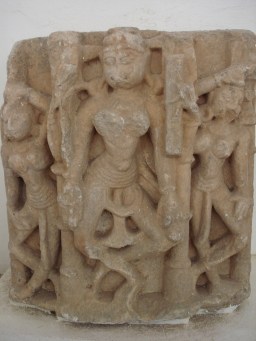
(An old Bengali song, and a 12th c. sculpture in Mewar.)

Tags:
Design a site like this with WordPress.com
Get started